
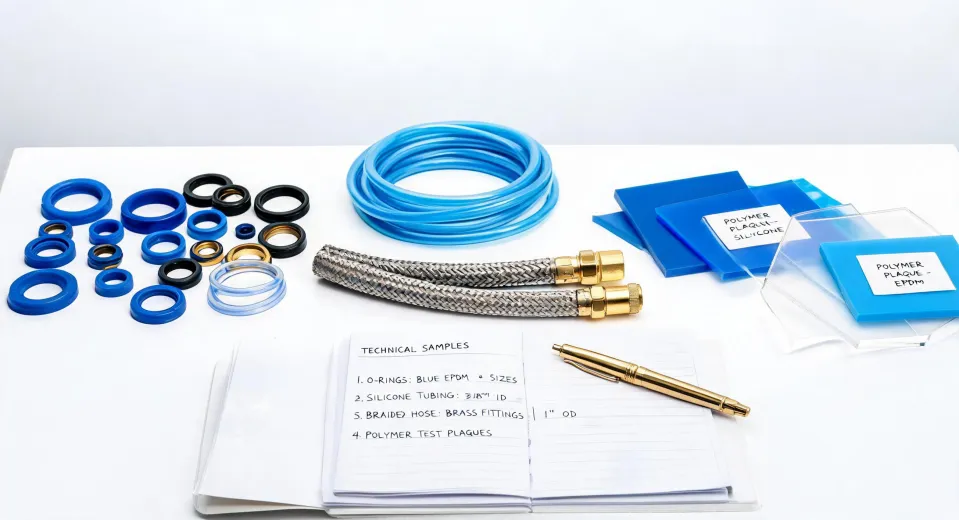
I've been running procurement for a 160-person manufacturing operation for about six years. Over that stretch, I've placed somewhere around 400 orders across a dozen vendors—PVC sheet and roll, HDPE stock, gaskets, foam board, the works. And after all that, I've arrived at a conclusion that tends to make sales reps uncomfortable: the more a supplier claims they can handle "anything plastic," the less confidence I have that they'll do the hard stuff correctly.
That's not a knock on ambition. It's just what the invoices and the rework tickets keep telling me.
The blindspot that costs you twice
Most buyers focus on the unit price per sheet or per roll. They completely miss whether the supplier actually has the right equipment for the specific downstream process. Those are two different questions.
A vendor that extrudes excellent PVC sheet might be the wrong choice entirely for a customer who needs HDPE welded into a custom tank liner. Different machine, different operator skill, different test standards, different everything.
I learned that the expensive way.
About three years ago, I assumed that because our regular shop sold us good PVC and PS sheet at fair prices, they'd also be a solid source for plastic welding HDPE. It made sense on paper. I didn't verify. Turned out their welding setup was tuned for thinner thermoplastics. The first three custom liner panels came back with cold welds that failed a hydrostatic test at 40 psi. We spent two weeks and roughly $3,800 on rework. Not catastrophic, but avoidable.
Now I ask a specific question: "What's the thickest material you routinely weld, and what test method do you use to verify the seam?" If they can't answer in under 30 seconds, they're not a welding shop. They're a sheet shop that dabbles.
The specialists make everyone else look bad
When I needed a rubber gasket supplier for a sealing project, I didn't call the sheet guy. He would've said yes—he says yes to everything. Instead, I called a shop that does nothing but gaskets. Their sales engineer asked me three questions about compression set and durometer that I'd honestly never heard before. That's the moment I knew I was in the right place.
There's something satisfying about that. After years of vague reassurances from generalists, finding a supplier who can actually talk shop—who pushes back, who wants the spec sheet, who tells you your first idea won't work—that's the payoff. It doesn't feel like a sales call. It feels like a conversation with someone who's solved your problem before.
Foam board was the same story. I spent almost a month trying to figure out where I could find foam board with the right density and thickness for a packaging insert we were redesigning. Every supplier said "yeah, we have foam board." Not one of them could tell me the compression rating or the density tolerance. Eventually, a packaging rep pointed me toward a converter who specializes in foam. He answered the question in his first email. I've bought every foam order from him since—about eight orders now, if I'm remembering right.
The question everyone asks is "where can I find foam board?" The question they should ask is "who actually understands foam board?" Very different question.
"But one-stop shopping saves time."
I hear this from our operations manager roughly every quarter. Consolidating vendors means fewer POs, fewer invoices to reconcile, fewer phone calls when something goes sideways. Real benefits. I'm not arguing against that.
But here's the math I keep bringing back: one late or wrong shipment from a "full-service" supplier costs me more in administrative cleanup than managing four specialist vendors for an entire year. I tracked it loosely through 2024—our three biggest vendor problems that year were all from suppliers stretching beyond their core competency. The specialists had zero escalations.
And I don't expect every supplier to be everything, either. Our regular sheet purchasing runs through the 3m store online—that's what it's built for, and it's reliable for it. But I don't call the 3m store when a different department needs 3m wood filler for a maintenance project, and I don't expect the 3m store to be my rubber gasket source. Different lanes, different specialists.
My test for new vendors
Before I place a first order with any new supplier, I ask one question: "What's something you don't do?"
The good ones answer instantly. "We don't do thermoforming." "We don't touch cast acrylic." "We don't handle PVC foam." And then—this is the part that wins me over—they usually add, "For that, you should talk to [someone else]."
That's the supplier I want handling everything else I need. A vendor who knows their limits is a vendor who won't quietly ship you a bad batch and hope you don't test it.
Per FTC advertising guidance (ftc.gov), suppliers have an obligation to make claims that are truthful, not misleading, and substantiated with evidence—including claims about what they can manufacture. In practice, "we can make anything" is a claim. Treat it like one.
What I actually do now
Here's my current setup, roughly:
- Sheet and roll stock (PVC, PET, PS, ABS, PP): 3m store, standard orders
- HDPE fabrication and welding: local specialist, verified test method
- Gaskets and sealing: dedicated gasket supplier
- Foam board and packaging inserts: foam converter
- Acrylic thermoforming: separate shop that only does thermoforming
That's more POs than our operations manager likes. But it's fewer emergency calls, fewer reprints, and fewer 3am worry sessions about whether a custom order is going to come back wrong.
The best part of getting our vendor process systematized this way: no more scrambling when someone needs something we don't stock. I know who to call, and I know who's actually good at it.
A short note on "we can do anything"
If a supplier tells you they handle gaskets, welding, foam, sheet, thermoforming, and custom fabrication all under one roof—ask for references in all six. Not one. Six. If they can't produce them, they're a sheet supplier with a website that overpromises.
That's the whole argument. The vendor who told me "this isn't our strength—here's who does it better" earned my trust for everything else. The one who promised the moon got me a $3,800 rework bill.
I know which one I'm still buying from.