
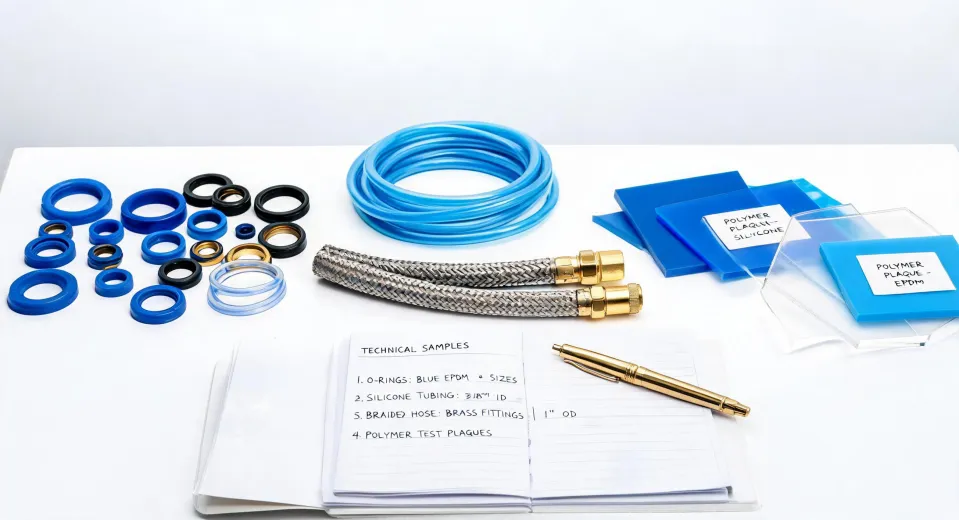
There's no "best" sealing solution — only the one that fits your downtime window
I get this question maybe once a week: "What's the best sealant for this?" or "Which O-ring should we stock?" And my honest answer is usually, "Depends on how many hours you've got."
That sounds like a dodge. It's not. I coordinate emergency orders for a materials supplier — I've handled more than 400 rush jobs in the last five years. Some were 4am calls from a plant that couldn't stop the line until the night shift ended. Some were weekend scrambles for a single dow corning 3145 rtv silicone adhesive tube. A handful were week-long changeovers where someone waited too long to order an oil-resistant buna-n o-ring.
Let me lay out the framework first, because the answer really does branch depending on three things:
- Time you actually have. Not "when can we get it" — but "how long until the line has to be running again."
- What failed. A joint, a sealing face, an O-ring, or a hose — different paths.
- What's in the system. Oil, heat, pressure, vibration. An oil-resistant buna-n o-ring and a standard nitrile O-ring might share a catalog number, but they don't behave the same after a week in hydraulic fluid.
I'll walk through three windows: 4-8 hours, 24-48 hours, and a full week. Then I'll tell you how to figure out which bucket you're actually in.
Scenario A: You've got 4 to 8 hours
This is the "pump is leaking and we need it running before the next shift" window. Nobody's calling a supplier for a same-day delivery unless it's already on the shelf somewhere.
When it applies: non-critical path leak, line can limp along for a few hours, or you're looking at a full stop if this isn't addressed today.
What I reach for:
- Dow Corning 3145 RTV silicone adhesive. It's a one-part RTV — room-temperature-vulcanizing silicone. No mixing, no special equipment. For most metal-to-metal or metal-to-plastic emergency repairs, it's the first thing I grab. It skins over in a couple hours and reaches full mechanical strength in about 24 hours at room temperature, which means you can get initial sealing well before that. I want to be clear: it's not a structural, permanent fix. It's what holds the line until the next planned shutdown.
- A temporary O-ring or field-fabricated gasket. If I've got a standard-size oil-resistant buna-n o-ring in stock, great — swap it in. If not, a field-cut gasket is a stopgap, not a solution. To answer the obvious question of what is an o-ring used for: it's an elastomeric sealing ring that gets compressed between two surfaces to block leakage. In an emergency, you're restoring the squeeze, not reinventing the seal.
- An air hose supplier that can overnight. If a hose blew, that's exactly what you need to be calling. Don't try to "make it work" with tape and clamps — compressed air isn't forgiving. A blown temporary coupling at 100 psi clears the space around it pretty fast.
What not to do: Don't expect any RTV to behave like a permanent fix under heat or continuous oil exposure. Dow corning 3145 is excellent at what it does — one-part cure, good adhesion, decent temperature range — but it's buying you time, not solving the underlying issue.
One that still stings: In March 2024, a client's hydraulic system failed on a Thursday afternoon at 5pm. They had a shipment going out Friday. The replacement part was days away. We patched it with Dow Corning 3145 RTV and got the pump running by Friday morning. By Monday, the correct O-ring had arrived and we did the real repair. The temporary fix wasn't pretty, but it saved a $12,000 shipment. I've also seen the opposite — someone patches with the wrong material, it fails within hours, and a $300 savings turns into a $3,000 mess.
Scenario B: You've got 24 to 48 hours
You've got a weekend. Or a single shift that's dark. Enough time to do it right, but not enough time to wait on a special order from a manufacturer.
When it applies: a known-bad O-ring, a joint that needs resealing, a hose that definitely needs replacing.
What I reach for:
- Oil-resistant buna-n o-rings. Nitrile (NBR) handles oil, fuel, and hydraulic fluid well. Under the ASTM D2000 classification system, Buna-N is a solid default for a lot of industrial sealing work within its temperature range. This is the moment to swap out the standard nitrile rings that start getting brittle after a summer of heat cycling.
- Dow Corning 888 silicone joint sealant. It's a one-part, neutral-cure silicone sealant used mostly for expansion joints and panel seams. In an industrial setting, it's the right call for sealing joints that need some movement capability and weather resistance — not for bonding parts together, but for sealing seams that need to stay sealed while the substrate moves.
- An air hose supplier you can qualify. This window is where you actually do the qualifying. Ask not "who's cheapest" but "who can guarantee delivery by tomorrow morning." That's a different conversation.
What not to do: Don't buy from a source that has to order the part from a distributor. A 24-hour window doesn't survive a two-day lead time. Call the supplier that stocks what you need, confirm the spec in writing, and place the order. The $40 you save by going with the slightly cheaper option disappears the moment the part shows up two days late.
Scenario C: You've got a full week or more
This window looks easy. It's not. A full week is where people relax, take their time, and then panic on day six when they realize they ordered the wrong durometer.
When it applies: planned shutdown, multiple seals or hoses to replace, or a pattern of seal failures that suggests the material itself is the problem.
What I reach for:
- Spec first, stock second. Pull the actual dimensions, material, and durometer before you order. Don't just grab "whatever's in the bin" because it's on hand. If you need an oil-resistant buna-n o-ring, confirm it's actually Buna-N (NBR) and not a generic nitrile blend that acts differently at temperature.
- Total cost, not unit price. In my experience across hundreds of jobs, the lowest unit price has turned into the higher total cost in roughly 60% of cases — because the part fails early and you pay for it twice: once in labor, once in downtime. A Buna-N O-ring and a standard nitrile ring might be a few cents apart at the counter, but if the cheaper one fails inside a month, you're looking at a four-figure problem for a two-dollar difference.
- An air hose supplier that provides documentation. Ask for material certificates and pressure ratings. You're not just buying a hose — you're buying something that has to hold pressure safely for however long it's in service.
What not to do: Don't treat a week as unlimited time. A week turns into three days, three days turns into "can you get it here by Friday," and Friday turns into another 4am call.
How to figure out which scenario you're in
Two questions usually settle it:
- What's the cost per hour of downtime? If a stopped line costs more in one shift than the entire material replacement would, the right answer is often the Scenario A patch — but only alongside an order for the correct long-term part. Doing the temporary fix without ordering the real replacement is how you end up back here in two weeks.
- Is the failure predictable or random? A single O-ring that wore out is Scenario B. Multiple seals failing at once usually means the material choice or the operating environment is the problem — that's Scenario C, and the fix is more than a part swap.
Here's the thing I've learned the hard way: I once assumed "same spec" meant the same part across two suppliers. Didn't verify it. The first batch worked. The second batch had a slightly different durometer, and the seal failed within days. We lost a week of production chasing a problem that a two-minute check would have caught. Now our rule is simple — any emergency order gets the spec confirmed in writing, regardless of how long we've worked with the supplier.
There's also a quieter payoff here. After enough of these rush jobs, you start to see which failures are actually predictable — which O-rings dry out, which hoses crack, which joints start weeping under thermal cycling. The teams that stop having emergency sealant calls aren't lucky. They just learned to schedule the replacement before the failure schedules it for them.
That's the real bottom line: the $15 you save on a cheaper O-ring or the $10 you save on a cheaper tube of adhesive disappears about 30 seconds after the part fails. In my book, the value call is almost always clear — the more expensive part is the one that doesn't put you back on the phone at 4am.