
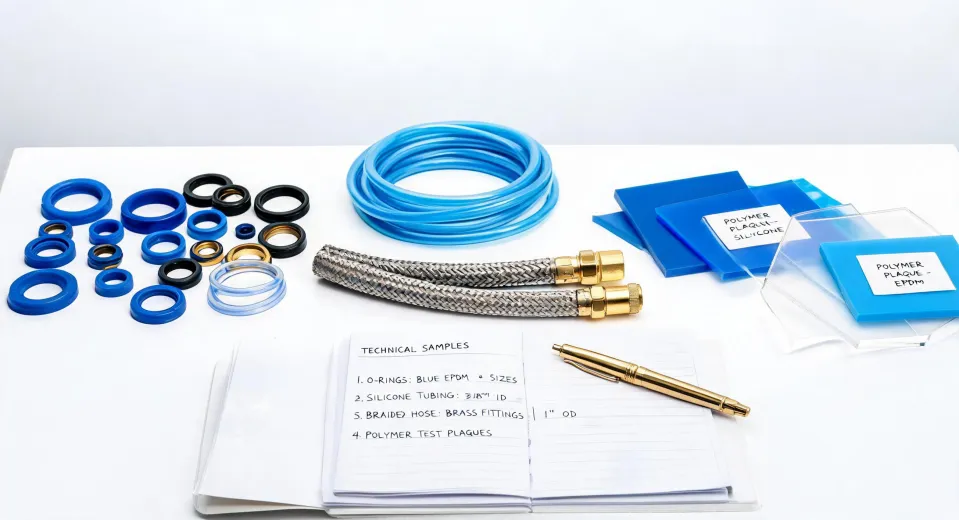
Pick the polymer by the environment it lives in, not by the price on the quote. That single rule would've saved me about $47,000 in scrap, rework, and rushed replacements over nine years of sourcing engineering plastics. I'm not exaggerating for effect—I have the spreadsheet.
The mistake I made three times before it finally stuck: treating material datasheets like shopping lists. You compare tensile strength, price per kilo, maybe a brand name you recognize, and you place the order. Then reality shows up six months later with cracked parts and a customer who's suddenly a lot less patient.
Why you should probably trust me on this
I handle polymer sourcing orders for a mid-sized industrial components supplier—nine years in, roughly 300 orders a year across PC, PU, TPU, PP, PETG, PTFE and whatever oddball grade a customer insists on this week. I've personally made and documented 23 material-selection mistakes. The $47,000 number isn't a rounded-up guess; it's the actual sum of scrap value, replacement freight, and the one time I ate a $6,800 rework bill just to keep a client.
I started keeping a checklist after the third rejection in Q1 2020. Since then we've caught 41 potential errors with it. The checklist covers application environment (indoor vs. outdoor, chemical exposure, temperature range), load type (static, cyclic, impact), regulatory requirements (food contact, flame rating, medical grade), and total landed cost including tooling and freight. Nothing fancy. Just boxes I wasn't checking.
Five minutes of prep before an order still beats two weeks of explaining why the parts failed.
The four mistakes that cost me the most
1. "Polypropylene is polypropylene" — $8,900 lesson
In 2018 we ordered 2,400 polypropylene polymers, standard homopolymer grade, for outdoor sensor enclosures. Agriculture customer, field-mounted, direct sun for 10+ months a year. The PP had excellent chemical resistance and ran about 30% cheaper than the PC/ABS alternative we'd quoted first.
Eight months in, 340 units came back—yellowed, chalky, cracked at the mounting bosses. UV degradation. The standard grade didn't have a UV stabilizer package, and nothing on the front page of the datasheet flagged that. It was buried in processing notes on page 14: "suitable for indoor applications."
Replacement parts, field service, and a very uncomfortable phone call: $8,900 total. The UV-stabilized grade would've cost $1,100 more upfront. That's the math I think about now.
And that's before we get into the fact that datasheets list properties at 23°C and 50% relative humidity—lab conditions. An agricultural field at 60°C surface temperature with condensation is not a lab.
2. PETG and TPU are not interchangeable, even when both say "tough"
2020, medical cart project. The customer spec sheet said "flexible plastic gaskets." I bought PETG because it's tough, it thermoforms easily, and I had 4,000 kilos in stock.
First installation batch: gaskets snapped at the sealing lip. PETG is tough—it's also rigid. It doesn't flex like a gasket needs to. TPU flexes. TPU bonds to itself. TPU handles repeated compression cycles. PETG does none of those things, no matter what the TDS says about impact strength.
1,800 pieces at $1.78 each plus tooling setup: roughly $3,200 gone. The customer was gracious about it. I was not gracious with myself.
Now I ask one question before any "flexible" order ships: does this part need to return to its original shape after deformation, or just survive one impact? That single question separates TPU from PETG from everything else.
3. Nobody actually knows what "PTFE plastic" means until you specify the grade
A customer called in 2021 asking what is PTFE plastic and whether we could quote a "Teflon-like" seal for a high-temperature valve. We quoted virgin PTFE. Chemically inert, handles 260°C continuous, friction coefficient around 0.04. Textbook answer.
Three months later the seal had crept—deformed under continuous load at 80°C. Virgin PTFE has terrible creep resistance under sustained load. Glass-filled or carbon-filled PTFE grades solve this. But nobody specified "filled" because the customer didn't know to ask, and we didn't educate.
That fix cost us $2,400 in replacement seals plus a painfully detailed technical email that I now send before quoting any PTFE part. What is PTFE plastic? It's at least six different materials wearing the same chemical name.
4. The Covestro login portal saved me more money than any sales call
We run a lot of Makrolon polycarbonate through injection molding—Covestro is one of our primary PC suppliers. In 2022 we produced 6,000 parts with silver-streak cosmetic defects. Everything in our process matched the old processing guide.
Turns out Covestro had updated the drying profile for that specific grade—longer dry time, lower dew point—and posted it on their customer portal four months earlier. We never checked. Covestro login isn't just for order tracking; the technical document library has revision histories you need to monitor.
We now have a standing calendar reminder to check the Covestro login portal for processing updates every quarter. Sounds trivial. Would've prevented $5,600 in scrap parts and a week of production delay.
On Covestro sustainability (and what "green" actually costs)
I get asked more and more about Covestro sustainability claims—bio-based TPU, recycled-content PC grades. My honest take after running quotes for virgin and bio-attributed material in 2024: the mechanical properties are close enough that most customers can't tell the difference in practice. The price difference is real, usually 10–20% at current volumes.
But here's where the transparency thing matters. Some suppliers quote a sustainability number without explaining the allocation method—mass balance vs. physical segregation. Mass balance means the "bio-based" material is mixed with fossil feedstock and allocated by bookkeeping, not physically separated. That's not greenwashing if it's disclosed. It is greenwashing if the sales rep implies every pellet came from a corn plant.
I ask for the allocation method in writing now. I also ask for a line-item breakdown of the price delta—is the premium from feedstock cost, certification fees, or just margin? Vendors who answer straight, even when the answer is less impressive ("it's mostly certification and margin"), get more of our business. The ones who dodge behind a logo? I stop calling.
Same principle applies to every quote: ask what's NOT included before you ask what it costs. Hidden tooling amortization, minimum order penalties, technical support fees—these show up after you've committed. A vendor who lists them upfront, even with a higher total, usually ends up cheaper. I've tested that on close to 80 orders now.
When this advice doesn't apply
Two honest caveats. First, if your application is genuinely non-critical—packaging inserts, prototypes, internal fixtures—the environment-first rule is overkill. Buy the cheap grade, ship it, move on. I do.
Second, if you're locked into a validated process (medical devices, automotive PPAP), you probably can't switch material families even when it would solve a problem. Requalification costs dwarf the material savings. The checklist won't help you there—it'll just make you more aware of the risk you're already carrying.
My approach is built for the messy middle: functional parts with real consequences but no regulatory moat. That's about 70% of what crosses my desk. For the other 30%, the checklist gets shorter—but the questions get harder.