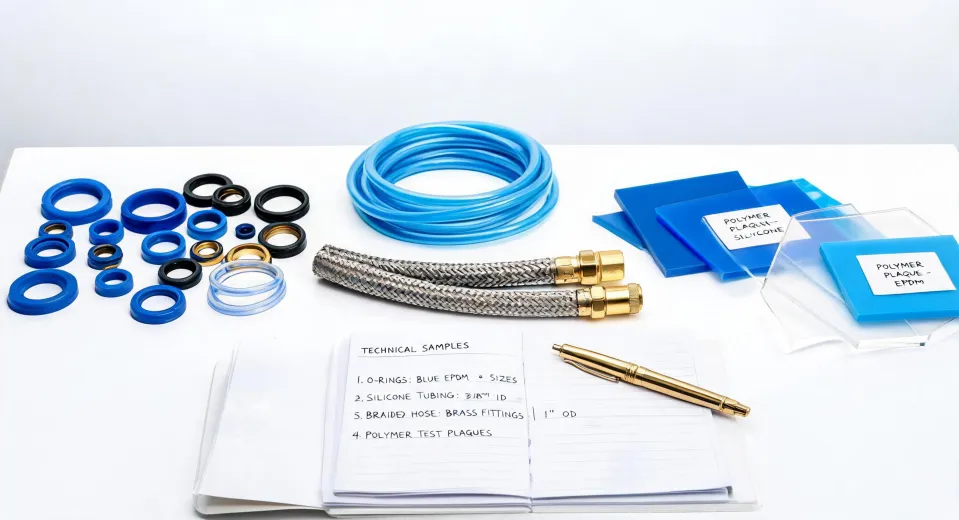
Last March, I signed off on a $4,200 order for EPDM seals. The purchasing director asked why I hadn’t taken the $1,900 quote from a different supplier. My answer: the $1,900 quote didn’t include the three-week lead time, the unverified compound, or the two-hour drive to test samples before production. The other supplier called their product “an equivalent” to the specified Trelleborg EPDM compound. They were not the same, and I knew it.
I’m a procurement manager at a 140-person industrial components distributor. I manage about $380,000 a year in polymer parts and hydraulic hoses. I’ve negotiated with more vendors than I can count, and I’ve documented every order in our ERP system since 2018. When I say cheap parts cost more, it’s not a slogan. It’s arithmetic.
That distinction—between “cheap” and “less expensive”—has driven everything I’ve changed about our purchasing process over the last seven years.
The problem with “just get three quotes”
For years, we bought polymer components the way most B2B buyers do. Send a drawing. Write “EPDM” or “polypropylene” on it. Get three quotes. Pick the lowest. File the paperwork. It looks like savings on the invoice. But the part fails six months later, and the real cost lands somewhere else: warranty labor, expedited freight, a customer relationship, a missed season.
Example: a customer’s spec sheet arrived from their Swedish office with the words “PVC fönster Trelleborg” written in the sealing-system line. The engineer wasn’t asking for a window brand. They were specifying Trelleborg’s EPDM profile—the sealing system engineered for that PVC frame’s thermal and compression requirements. Our buyer found an “equivalent” gasket from a cheaper supplier. It looked identical. It cost 38% less. It also didn’t compress the same way, so the glazing bead sat wrong and the corner joints leaked air in the thermal test. The entire batch failed inspection. That $1,900 “saving” turned into roughly $5,200 in replacement costs, freight, and a very awkward quality review.
What I kept underestimating
When I audited seven years of spending, I found that every meaningful budget overrun came from a few recurring blind spots. These are the ones I still explain to new hires.
“EPDM” is a name, not a specification
EPDM—ethylene-propylene-diene terpolymer—covers compounds formulated for freezer duty, under-hood heat, UV exposure, ozone, brake fluid contact. All of those are “EPDM,” and none of them is interchangeable. That’s why you see “Trelleborg EPDM” written into specs so often. It’s not brand loyalty. It’s shorthand for a defined compound with published compression set, hardness tolerance, and aging data. Why does that matter? Because a seal that loses compression isn’t sealing—it’s just a rubber shape.
The “all EPDM is the same” thinking comes from an era when there were maybe a dozen standard compounds and everyone knew what they were. That era is gone. We accepted a no-datasheet substitute once because the price was right. I said “same compound as the approved sample.” They heard “same hardness, close enough.” The seals lost compression within 18 months, and the warranty replacement cost four times the original order value once labor and access were counted.
“Recyclable” is not the same as “actually recycled”
At a sustainability review in late 2024, our team proposed switching a polypropylene component to a “more recyclable” version. The supplier’s pitch leaned heavily on the phrase “polypropylene plastic recyclable.” Technically true. Practically? Our waste handler would not take the part. The molded-in metal insert and flame-retardant additives put it outside every local recycling stream we could find.
Per ISO 14021, a product carrying a recyclable claim should be collectable and recyclable in practice, not just in theory. Our “green” component would have needed manual disassembly and a cross-country trip to a specialty recycler. We kept the original design. (Should mention: we now ask every supplier three questions—exact resin grade, additive package, and where the part actually gets recycled at end of life. Two out of three suppliers can’t answer the third.)
Hydraulic hoses are bought by the meter but priced by the emergency
In 2023 I switched hose assembly suppliers to save $1,100 per quarter. The quote was lower. The samples looked fine. The hoses were fine, actually—the crimps were the problem. One assembly burst on a Monday morning, and the line stopped for six hours while we waited for a tech to rebuild it. At roughly $1,250 per hour of lost production, that one event erased an entire year of savings—and then some.
I now buy hydraulic hose service, not just hydraulic hose. The supplier pressure-tests every assembly, certifies it against standards we reference (SAE J517, EN 853), and carries enough local stock to respond same-day. In March 2024, we paid $400 extra for a rushed assembly that kept a $15,000 service window on schedule. That wasn’t a markup. It was the best insurance we bought all year.
The “how to glue polyethylene” trap
One of the most common search terms from our engineering team is “how to glue polyethylene plastic.” It makes sense: PE is cheap, tough, and chemical-resistant. But its surface energy sits around 31 dynes/cm, while most adhesives need a surface closer to 38 dynes/cm to wet and grip. Without corona, flame, or chemical etching, the bond is questionable. With preparation, it can be workable—but preparation becomes the project.
We once spent $900 on a specialty adhesive that claimed to bond PE directly. It worked beautifully in the demo, on a clean, freshly treated sample. It failed in the field, on a real part covered in grease and vibration. The correct answer was to overmold the PE onto a metal insert. Asking “how to glue polyethylene” was the wrong question entirely. Not ideal, but workable—what wasn’t workable was the field failure.
What the cheap quote actually hides
People assume the lowest quote means the vendor is more efficient. What they don’t see is which costs are being deferred or quietly added later.
- The $1,900 EPDM “equivalent” became a $5,200 replacement project.
- A “free setup” offer from a new vendor carried $450 in hidden file-conversion and expediting fees.
- The hose switch “saved” $1,100 per quarter and cost $7,500 in one shift of lost production.
When we finally ran a total-cost-of-ownership analysis on one product group, the exercise took about three months and saved us $8,400 a year—roughly 17% of that category’s spend. All from looking past the invoice.
What I do differently now
I’m not going to tell you to buy premium brands on principle. There are plenty of good generic rubber and plastic parts out there. But three rules govern every polymer purchase I make now:
- Get the material spec in writing. Datasheet or it didn’t happen.
- Compare cost per year of service, not cost per unit.
- Budget for delivery certainty. When a deadline matters, “probably on time” is a risk, not a plan.
One caveat: this approach worked for us because we’re a mid-sized distributor with predictable ordering patterns and enough volume to consolidate. If you’re a small shop buying a handful of parts a month, the calculus might be different. I can only speak to my context.
The bottom line
Next time a cheaper EPDM quote lands in your inbox, ask what the part costs per year of expected service, not per unit. Next time someone calls a polypropylene part “recyclable,” ask where and how. And next time you’re tempted to save money on speed, consider what certainty is worth.
Certainty has a price. Pay it. It’s almost always cheaper than the alternative.
In the end, the $4,200 order I defended last March wasn’t about rubber. It was about not learning the same lesson a fourth time.