“Do you have a Trelleborg silicone O-ring that can replace this?” The maintenance lead pointed at a flattened gasket on the bench. I manage purchasing for a 120-person packaging company across three locations, and I’ve been in this role since 2020. The word “replace” didn’t scare me. The lead time did. The OEM’s part was backordered six weeks, and our label laminator couldn’t wait that long.
That question turned into a crash course in o-ring materials, a portable air hose, and the difference between saving money and spending it wisely. I’m sharing it because if you search for “o-ring gasket alternative” or “PVC vs HDPE” the way I did, a little context saves you a long phone call.
Why the Original Gasket Didn’t Fit Our Schedule
The machine was a laminator that had been on our floor for nearly 20 years. It ran label stock with a water-based adhesive, and between batches the operator flushed it with hot water. Nothing exotic. But the original die-cut gasket came from the equipment manufacturer, and their stock room said 4–6 weeks.
Our regular seal supplier connected me to a Trelleborg applications engineer. His first question wasn’t “what’s the part number?” It was “what media is it sealing, at what temperature, and does it get washed down?” I had to walk to the machine and check. That alone told me the engagement was different.
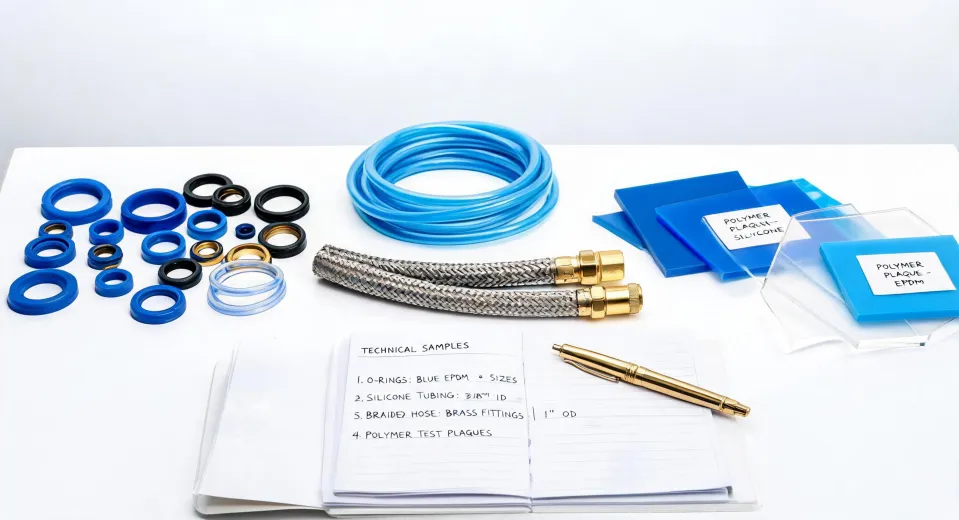
He suggested a compact retainer with two Trelleborg silicone O-rings, which could be installed without modifying the existing flange. In plain terms: an o-ring gasket alternative. The lead time from Trelleborg was four days.
Here’s what I learned early. An O-ring dash number can confirm dimensions, but it doesn’t confirm material compatibility. The sizing convention in ISO 3601 tells you the dimensions, not which compound can survive your washdown temperature or cleaning chemistry.
The Almost-Expensive Mistake
Before that Trelleborg quote arrived, I found a generic O-ring with the measured dimensions at half the cost. It looked perfect. Same diameter, same cross-section, silicone material. It was tempting to think an O-ring is an O-ring.
I submitted the PO. Then the Trelleborg engineer called me back to review the order. He asked which durometer and which compound we had selected. I didn’t know. He explained that a general-purpose silicone O-ring might handle room-temperature use, but our hot-water washdown was another story. It wasn’t just about size—it was about how the material held up under continuous heat and compression. The Trelleborg silicone material he recommended was specified for that kind of repeated washdown and had better compression set resistance.
I canceled the generic order before it shipped. That was the moment I learned what “prevention is cheaper than the cure” actually means. A five-minute conversation saved us from what would almost certainly have been a second failure.
I still kick myself for not asking the temperature question earlier. If I had called the Trelleborg rep before comparing prices, I would have saved an afternoon of unhelpful quote chasing. He sent a material compatibility chart from Trelleborg’s published data, and that became the document I kept in the maintenance folder.
A Separate Lesson: Portable Air Hose and the PVC vs HDPE Question
During the same shutdown, maintenance asked me to replace a portable air hose for the compressor that fed the laminator. 50 feet, quarter-inch fittings, quick-connect ends. I started reading product specs and saw “PVC vs HDPE” in the filter options. HDPE sounded stronger and more modern. So I asked the supplier: “Can I get this as an HDPE portable air hose?”
The answer: “No. HDPE is a rigid pipe. For a portable air hose, you want reinforced PVC or rubber.”
Looking back, it seems obvious. HDPE pipe is made for fixed installations, buried or inside a wall, where it won’t need to bend. A portable air hose has to flex, coil, and resist abrasion on a concrete floor. Comparing them by price alone misses the point. PVC was not the “cheaper” option in that comparison—it was the functional one.
The hose we ordered was a Trelleborg reinforced PVC air hose. It has been dragged across the shop floor many times and still fits the connector without leaking. The only extra cost was a couple of phone calls.
What I Do Differently Now
The Trelleborg silicone O-ring set was installed in the next weekend shutdown. The machine has run through two full weeks of production without leaks. I have also stopped treating “technical” purchases as if they were office supplies.
Before I place a maintenance order now, I ask:
- What does the part touch?
- What temperature and pressure are involved?
- Does the supplier know the original manufacturer and reference?
- Is the material recommendation documented in a data sheet or compatibility chart?
- Can they send an invoice-ready quote that finance won’t reject?
The last one came from a mistake in my early purchasing days, not from Trelleborg. It’s on the list because every half-saved dollar disappears if the bill doesn’t meet accounting requirements.
The Real Lesson: Prevention Beats Cure
I still have mixed feelings about paying a little more for a Trelleborg part. On one hand, the generic O-ring was half the cost. On the other, the branded material came with an engineer who warned me before I made a costly mistake. That’s not a marketing bullet point. It’s a procurement decision.
Five minutes of verification beats five days of correction. I’ve now seen it with seals and hoses and probably every other part category I’ll ever touch. If you’re looking for an o-ring gasket alternative, ask about operating conditions before you settle on a price. If you’re ordering a portable air hose, confirm whether you need PVC, rubber, or something rigid. And if you’re not an engineer by training, don’t be embarrassed: ask for the material data sheet, and keep it on file.
That checklist is the cheapest insurance I buy.