The Short Version
Three years ago, our maintenance team started tracking every seal failure that caused unplanned downtime. The results were uncomfortable: 78% of failures traced back to a single budget supplier we'd been using to save roughly $3,000 annually. When I added up the lost production hours, that "savings" had cost us over $40,000.
We switched to Trelleborg for our critical sealing applications. The upfront cost was about 22% higher. Our downtime dropped by 18% in the first year. But the bigger shift wasn't operational—it was how our clients started talking about us.
Why a Purchasing Person Is Writing About Seals
I'm not an engineer. I'm the office administrator for a 200-person manufacturing facility. I manage vendor relationships, process POs, and explain budget variances to finance. When I took over purchasing back in 2020, I thought an O-ring was an O-ring. I thought brand names in industrial components were mostly marketing fluff.
Here's the thing: they're not. And it took a client audit to make me understand why.
Our facility supplies components to several commercial clients. When a seal fails mid-production, we miss deadlines. Clients don't care that we saved 15% on our O-ring supplier—they care that their order is late. One client (a commercial bakery chain) actually sent an audit team after two consecutive late shipments. Their report mentioned "inconsistent maintenance practices" as a risk factor. That was the moment I realized our internal purchasing decisions were showing up in our external brand perception.
What I've Learned About the Materials
Managing these purchases since 2019 has taught me more than I ever wanted to know about polymer specs. Here's the practical breakdown, without the textbook language.
EPDM vs Silicone
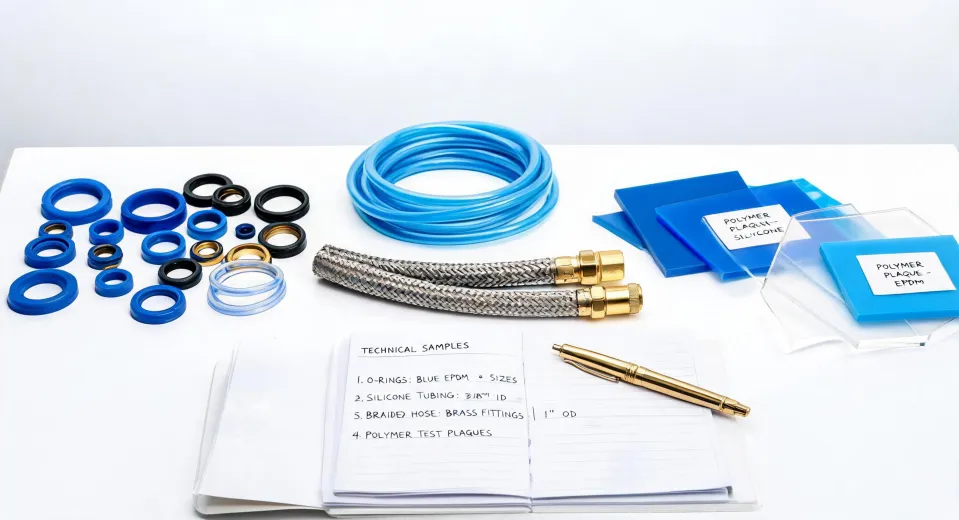
Trelleborg EPDM handles steam and hot water up to around 300°F. For our cold storage applications (down to -40°F), Trelleborg silicone stays pliable while EPDM gets brittle. Simple division of labor, but most budget suppliers don't stock both—so you end up compromising on one end of the temperature range.
The difference is noticeable. We had a budget EPDM seal crack during a cold snap in January 2023. The replacement from Trelleborg is still going strong (note to self: track that one's lifespan).
Polyurethane vs PVC
This one comes up a lot in our hose applications. PVC is cheaper—I got quotes at $8–12 per meter in early 2025—but it cracks under constant flex. Polyurethane costs $15–22 per meter but lasted three times longer in our robot arms. The math changes depending on your application. If the hose sits still, PVC is fine. If it moves, polyurethane wins.
And no, I don't have a perfect cost-per-hour formula. I wish I did. What I have is a spreadsheet of failure dates and a growing distrust of the cheapest option.
The "O-Ring Sealant" Question
Someone asked me last month about o-ring sealant. I had to look it up—most O-rings don't need sealant if the groove is properly designed. We learned that the hard way when a contractor used sealant on a Trelleborg EPDM O-ring assembly that didn't need it. The chemical interaction caused premature failure. Cost us $1,200 in replacement parts and a full day of downtime. The sealant wasn't compatible with EPDM (should've checked the spec sheet).
Where Brand Perception Actually Shows Up
Here's the connection I didn't see coming.
Our clients judge us on output. They don't see the O-rings, the hoses, or the plastic fittings. But they see late shipments, quality variations, and equipment downtime. All of those trace back—at least partially—to the components we buy.
When we switched to Trelleborg for sealing applications, two things happened:
- Downtime dropped 18% in year one
- Client complaints about "delivery consistency" dropped noticeably
The second one is harder to quantify, but I track complaint rates. It's real.
I used to think brand names in industrial components were mostly marketing. I was wrong. When your production line is down and you're waiting on a $4 O-ring, the brand that gets you a replacement in 24 hours with verified specs starts looking pretty reasonable.
What I'm Not Saying
Look, I'm not saying Trelleborg is the only answer. If you're running non-critical applications—a drainage hose, maybe, or a low-temp seal that never sees pressure—the budget option is probably fine. I still order generic PVC tubing for our wash-down stations. It's cheap, it works, and if it fails, it fails visibly before anything bad happens.
But for anything where failure means downtime, customer impact, or safety issues? The material quality matters. And increasingly, so does the technical documentation and support behind it. Trelleborg's spec sheets and technical support saved my team hours of guesswork (I really should document which resources were most useful).
The uncomfortable truth: I saved $3,000 annually on the budget supplier. I spent over $40,000 in downtime-related costs. That's not a rounding error—that's a budget line I had to explain to finance. The cheap option wasn't cheap.
If you're managing industrial purchasing and you haven't tracked your seal failure rates, start there. The numbers might surprise you.