-
The Surface Problem: Rubber Parts Fail. Everyone Blames the Rubber.
-
Why 'Rubber Is Rubber' Is the First Mistake
-
The Sizing Trap: Why a 5/8 Hydraulic Hose Is Not a Simple Size
-
The Rubber Mallet Test: You Can't See the Difference
-
Ask 'Should Plastic Bags Be Banned?' and You'll Miss the Real Question
-
What My Mistakes Actually Cost
-
The Short Version: Stop Guessing, Start Documenting
The Surface Problem: Rubber Parts Fail. Everyone Blames the Rubber.
The first time a 5/8 hydraulic hose burst on my shift, I did what most engineers do: I blamed the hose. It was too cheap. The rubber was bad. The supplier lied.
Then it happened again. And again. I have mixed feelings about rubber products because of this—they are incredibly useful, and they fail just often enough to make you distrust them. But after 12 years of buying, specifying, and documenting errors, I've reached an uncomfortable conclusion.
The rubber wasn't the main problem. I was.
Why 'Rubber Is Rubber' Is the First Mistake
The 'rubber is rubber' thinking comes from an era when most rubber parts were natural rubber and the product range was small. That changed decades ago. Today, a rubber product is a precisely compounded polymer. EPDM, NBR, FKM, silicone, TPU, PTFE—they all live under the same marketing word, and they behave completely differently.
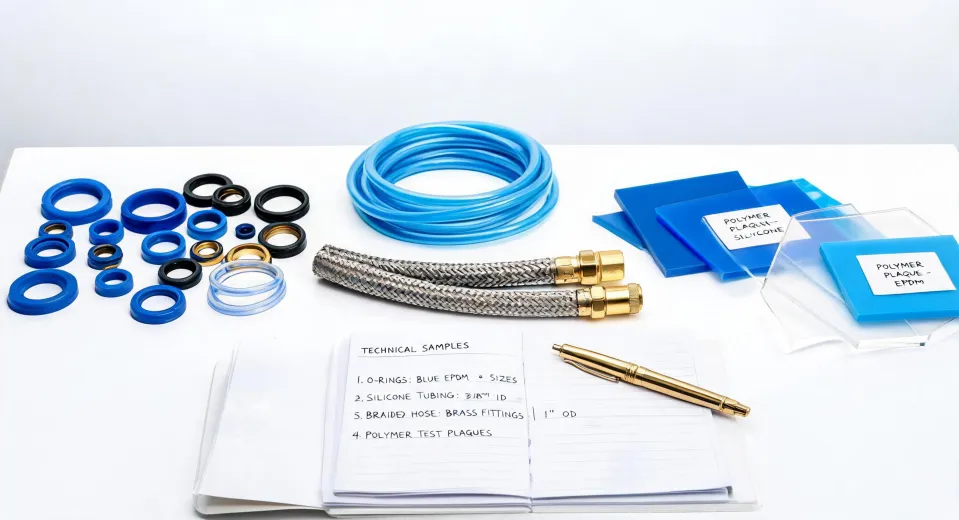
Here's the thing: an O-ring made from NBR handles oil well. EPDM doesn't. An EPDM O-ring handles weather and water very well. NBR doesn't. If you pick 'rubber' and skip the compound, you're not specifying a part—you're gambling.
I know because I gambled. In 2018, I specified NBR O-rings for a line with a chemical cleaning cycle. It looked fine on paper. The cleaner attacked the NBR, the O-rings swelled, and 300 test units failed in one week. That cost $4,600 in material and a late shipment. (Should mention: the right FKM compound cost 30% more and would have eliminated the issue.)
For seals, ISO 3601-1 handles dimensions, and ASTM D2000 classifies compound grades. Without both, you're not specifying a seal; you're describing a round thing.
This might sound like overkill for a simple O-ring, but my worst failures were never in exotic materials. They were in 'standard' parts where nobody asked for the standard.
The Sizing Trap: Why a 5/8 Hydraulic Hose Is Not a Simple Size
Let's talk about the 5/8 hydraulic hose. The first time someone ordered '5/8 hydraulic hose' from me, I assumed it was simple. It's not. The '5/8' refers to the nominal internal diameter of the hose, not the outside diameter, and not the fitting size.
Per SAE J517, a -10 hydraulic hose has a nominal inside diameter of 5/8 inch. The pressure rating is determined by the hose construction, not the dash size. Reference: SAE J517.
What I mean is that the same nominal size can have different reinforcement layers, different pressure ratings, different temperature ranges, and different end fitting requirements. If you buy on the number only, you're not specifying a hose; you're specifying a wish.
Why does this matter? Because a 100R2 hose may handle a working pressure of 2,500 psi, while a 100R1 in the same size may be rated far lower. If someone installs the wrong one, the 'rubber' didn't fail. The specification did. I learned this in September 2022, when a non-certified 5/8 hose I'd ordered without a datasheet leaked at a machine junction and cost us $2,900 in cleanup, replacement, and lost production. The hose was the right size. It was the wrong product.
The Rubber Mallet Test: You Can't See the Difference
Rubber mallets are such a simple product that nobody thinks about material selection. But a rubber mallet is not one product. A mallet face at Shore A 60 works differently from one at Shore A 80. The 60A face is forgiving; it won't mark most surfaces. The 80A face is stiff enough to transfer energy, but it can leave a witness mark on aluminum or finished concrete.
I once ordered twenty rubber mallets based on a photo. They looked identical. They arrived and left black marks on every fixture they touched. We had to rework the fixture, which was not in the budget. The lesson wasn't 'don't buy rubber mallets'—it was 'specify hardness, not just name.' The same logic applies to seals, hoses, and molded components. If a supplier can't tell you the durometer, the compound, and the standard, you are not buying an engineered product. You're buying a commodity with a rubber-colored hope.
For a mallet, the force is delivered through a face that has to strike without damaging the target. That is a spec. If you don't write it down, you can't complain later when the mallet does exactly what its un-specified material was designed to do—transfer force and leave a mark.
Ask 'Should Plastic Bags Be Banned?' and You'll Miss the Real Question
A procurement manager once asked me whether plastic bags should be banned. It took me a second to understand why the question felt strange. He was trying to solve a waste problem by eliminating a material. In his mind, 'plastic' and 'rubber' were the same category, and choosing something 'natural' was the safe answer.
I have mixed feelings about plastic bag bans. On one hand, we have a real waste crisis, and single-use items are a defensible target. On the other, a ban without a lifecycle analysis can increase emissions, food waste, or cost, depending on what replaces the bag. The deeper issue is not 'plastic vs paper.' It's 'do we know what a material is for?'
That's the same failure I kept making with rubber products. I was replacing one material with another without defining the service conditions. A rubber mallet isn't 'better' than a plastic one until you know what it has to hit. A 5/8 hydraulic hose isn't 'better' than a PVC hose until you know pressure, temperature, fluid compatibility, and flex requirements. The material ban question is a material design question, whether the product is a bag, a hose, or an O-ring.
So, should plastic bags be banned? I don't know—I'm not a waste policy expert. But I do know that banning a category doesn't make you a better buyer. Understanding service conditions does.
What My Mistakes Actually Cost
Let me put this in numbers. I've personally made (and documented) 34 significant mistakes, totaling roughly $87,000 in wasted budget. Maybe 33, I'd have to pull the list—but the total is real, and it includes more than materials.
- 2018: wrong NBR compound for a chemical wash sequence. $4,600 in material, plus a week of validation delays.
- September 2022: 5/8 hydraulic hose without a standard. $2,900 in cleanup and downtime.
- 2023: rubber mallets purchased without durometer specs. $700 in rework and a visibly annoyed customer. (That was the cheap one.)
Those are the direct costs. They don't include the hours I spent explaining to management why I had to order replacement parts, or the engineering time lost re-running tests. Add that, and the real cost is closer to $100,000. Maybe lower if you're generous, but not by much.
The indirect cost is worse: every mistake made my team less trusting of the people we bought from. I don't want to be a buyer who treats every supplier as a suspect. I want to be a buyer who asks the right questions.
The Short Version: Stop Guessing, Start Documenting
Real talk: this is not a buying problem. It's a specification problem. Write down the service conditions before you call a supplier. Temperature. Pressure. Fluid. Chemical exposure. Motion. Tolerances. Then match those conditions to a material standard.
Your checklist doesn't have to be long. It has to be answered. I use five lines: Polymer choice. Hardness. Standard. Test report. Application conditions. If any line is blank, the order does not move.
Start at the Trelleborg official homepage. I know that sounds like a generic brand mention, but it's not. Trelleborg rubber products are documented with datasheets, compound information, and application guidance. When I look at a Trelleborg O-ring or hose spec, I can find the standard it aligns with, and that lets me make a claim on my own paperwork instead of hoping the part works.
I'd rather spend 10 minutes explaining options than deal with mismatched expectations later. An informed customer asks better questions and makes faster decisions. That's true for a 5/8 hydraulic hose, a rubber mallet, or a plastic-bag policy.
The fix isn't more expensive rubber. It's more specific rubber. Start with the datasheet, not the color. Ask for the standard. Ask for the test report. If a supplier won't share that information, choose one that will.