
-
Check 1. Name the actual material, not the nickname
-
Check 2. The x-ring vs o-ring question starts with the application
-
Check 3. Door rubber strip: measure the profile, not the gap
-
Check 4. “Trelleborg rubber hose” needs a working condition
-
Check 5. “Polypropylene plastic” is a starting point, not a spec
-
Check 6. When the deadline is tight, buy certainty
-
Mistakes I still watch for
I'm an office administrator at a 400-person manufacturing company. Since 2020 I've handled MRO purchasing—seals, hoses, strips, and plastic components—which works out to roughly $350,000 a year across eight vendors. I report to both operations and finance, which means every wrong order gets remembered twice.
When I first started, I thought buying a rubber hose was about as complicated as buying printer paper. Pick a trusted brand, compare prices, press enter. Then I ordered a “Trelleborg rubber hose” using the outside diameter instead of the inside diameter. The hose arrived, didn't fit, and I learned that a brand name is not a specification.
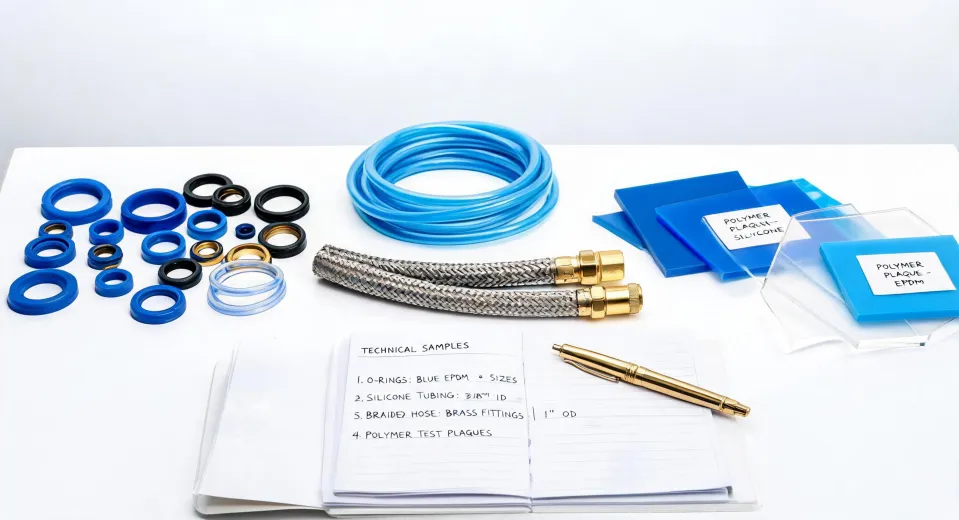
This checklist is for people who don't have a materials engineer on call but still have to place these orders. I run six checks on any rubber or plastic part purchase:
- What material is it, actually?
- Is the application static or dynamic—the x-ring vs o-ring question?
- What is the exact profile of the door rubber strip?
- What will the hose carry?
- What does the polypropylene part need to resist?
- What is one day of delivery delay worth?
Check 1. Name the actual material, not the nickname
Real talk: “rubber” is a category, not a material. EPDM, silicone, nitrile (NBR), and TPU are all rubbers, and they don't behave the same way. EPDM handles sun, ozone, and water, which is why it's common in outdoor weatherstripping. Silicone stays flexible across a wider temperature range, which is why freezer or oven seals are often made from silicone. Nitrile is the oil-resistant workhorse. Choose by guesswork and you pay for the part twice—once for the component, once for the labor to install it.
If the request already says “Trelleborg silicone,” look for the part number anyway. If there isn't one, add detail: solid or sponge, hardness for solid material, temperature range, and what the seal touches. Solid silicone at 40 Shore A is not the same product as solid silicone at 70 Shore A. The brand gets you only part of the way there.
Check 2. The x-ring vs o-ring question starts with the application
When people ask about x-ring vs o-ring, they usually want to know which one is “better.” I used to think the x-ring was basically an upgraded o-ring because its cross-section looks cleverer. It isn't that simple.
An o-ring has a round cross-section, fits standard grooves, works well for static applications, and is usually the more economical choice. An x-ring has an X-shaped cross-section with four sealing lobes. It is often used in dynamic applications where lower friction and less stick-slip matter, especially when lubrication is light. Different tools, different jobs.
So before you put “x-ring” on a purchase order, ask the person who requested it one question: does the seal sit still, or does it move? For a static flange, an o-ring is a normal choice. For a reciprocating rod or piston, an x-ring might be the right call. And if you're replacing an existing o-ring with an x-ring, don't guess—check the groove dimensions with the supplier first.
Also write dimensions down properly: inside diameter and cross-section, with units. In the U.S., inch-size o-rings are often described with the SAE AS568 dash number. If that number isn't available, give the inside diameter and cross-section in millimeters. “1-inch o-ring” doesn't tell anyone whether you mean the inside or the outside.
Check 3. Door rubber strip: measure the profile, not the gap
Here's the step most people skip, and it's the one that causes the most returns. If the only description on the request is “door rubber strip,” you are missing the details that make the seal fit: shape, hardness, attachment method, and length.
Do not measure the width of the gap with the old strip still installed. Old weatherstrip shrinks, flattens, and twists, so the gap is not the profile. Cut a small piece from the end of the old strip and look at the cross-section. Is it solid rubber or sponge? Is it a bulb shape, a P shape, or a flat tape? Does it slide into a channel, clip onto a flange, or stick on with pressure-sensitive adhesive? Measure the uncompressed width of the sealing bulb at its widest point, and take a photo with a ruler next to it.
Length has its own trap. If the strip fits around the door perimeter, measure the full run—header plus both sides. Door width is only the right length for a bottom sweep. If the strip goes around the sides and top, door width alone will leave you short.
For material, EPDM is a common choice for exterior doors because it stands up to weather. Silicone can be a better option where the seal must flex at very low temperatures. If the old part has markings, use those markings instead of guessing.
Check 4. “Trelleborg rubber hose” needs a working condition
I feel a bit defensive writing this because it's exactly how I placed my first hose order. “Trelleborg rubber hose” tells the supplier which manufacturer's catalog to open, but it doesn't tell them which page.
Before I call the supplier, I collect five things:
- What is flowing through it—air, water, oil, or something else?
- Working pressure, and whether there are pressure spikes.
- Minimum and maximum temperature.
- Inside diameter. Most hoses are sized by I.D., not O.D.
- End fittings or the type of connection, plus the length you need.
If the hose is part of a hydraulic line, add the dash size and fitting details; don't assume one “hydraulic hose” replacement fits every application. And if the old hose has printed text along its side, copy that text onto the order. It often contains the part number and specification that answer every follow-up question.
Check 5. “Polypropylene plastic” is a starting point, not a spec
One drawing I was handed said “material: polypropylene plastic.” and nothing else. Polypropylene is a family of plastics with different properties. Sometimes the application doesn't care. Sometimes the choice between homopolymer and copolymer, glass-filled and unfilled, UV-stabilized and natural, makes the difference between a part that lasts and a part that fails in the first season.
When I see “polypropylene plastic” on a requisition, I ask what the part touches. Is it outdoors? Will it see chemicals? Does it carry a load? Does it need to be food-contact safe? If food contact is in scope in the U.S., I ask the supplier to confirm compliance with FDA 21 CFR 177.1520 instead of doing my own chemistry. If it's for an EU customer, I ask for a REACH declaration. This isn't bureaucracy. It's a five-minute check that stops an expensive repeat order.
Check 6. When the deadline is tight, buy certainty
This is the check that has saved us the most money, even though it sometimes makes the invoice look worse.
A rush fee used to feel like gouging. I still have mixed feelings about expedite charges. But after watching a supplier pull resources together for an emergency order, I understand why they charge a premium: expedited service isn't just “drive faster.” It means reserving capacity, interrupting another schedule, and guaranteeing a result.
In March 2024, a compressor hose failed. The replacement hose was about $95. Standard shipping was $48 with an estimated five-day arrival. The guaranteed next-morning option added $185. On paper, that looks like a bad deal. In real life, the maintenance manager estimated the line would lose roughly $3,200 per day if the hose didn't arrive. Paying $185 to remove the risk of a $3,200 delay was the obvious call.
Look, I'm not telling you to pick the fastest shipping on every order. If a replacement can wait a week, I take the ground option and keep the budget. But when the cost of a late delivery is higher than the rush fee, “probably on time” is the riskiest choice on the table. Ask for a written delivery commitment, not just an estimated date.
Mistakes I still watch for
Even with these six checks, an order can go sideways if the details aren't written down. I review every confirmation for the same four mistakes:
- Missing units. A part ordered in the wrong unit won't fit.
- Diameter confusion. For seals, inside diameter and cross-section are both part of the spec. For hoses, the bore is usually the inside diameter. Write the words “inside” and “outside” instead of assuming.
- Photos without a ruler. A photo of an old seal is helpful, but it doesn't show dimensions if there's nothing in the frame to scale.
- No datasheet. If a supplier can't provide a datasheet for the material or product, that's a red flag. It means the product doesn't have defined properties.
The process sounds like extra work, but after a few orders it takes about fifteen minutes. Since I put this checklist into our request form, the number of wrong rubber and plastic orders has dropped by more than half. And there's a quiet satisfaction when a replacement seal or hose fits the first time—not a hero moment, just no phone call afterwards.
Bottom line: if you don't know the material, the profile, the units, or the true deadline, you don't have a purchase order yet. You have a guess.