I've handled polymer component orders for eight years. In that time, I've personally made and documented six significant material selection mistakes. Total wasted budget: roughly $11,000.
That's not a flex. It's the opposite of a flex. But it's why my team now has a pre-order checklist that has caught 47 potential errors in the past 18 months. This article covers three of those mistakes—$4,040 worth—and the pattern behind them.
The Order That Looked Perfect on Paper
2018. A water treatment line in our plant needed gaskets for PVC pipe joints—standard 4-inch solvent-weld pipe, nothing exotic. I placed the order with a distributor, describing what I wanted as "Trelleborg rubber seals."
I'd made similar orders before. None had failed. I had a comfortable mental model of rubber: black, flexible, smells faintly industrial. A seal is a seal, right?
Six weeks later, the seals were cracking. Not all—just enough to frustrate the maintenance crew and force emergency reorders. I was annoyed at the manufacturer. Then the distributor's engineer asked a question that made my stomach drop: "What compound did you specify?"
I hadn't. I'd specified a brand name.
"Trelleborg Rubber" Is a Category, Not a Material
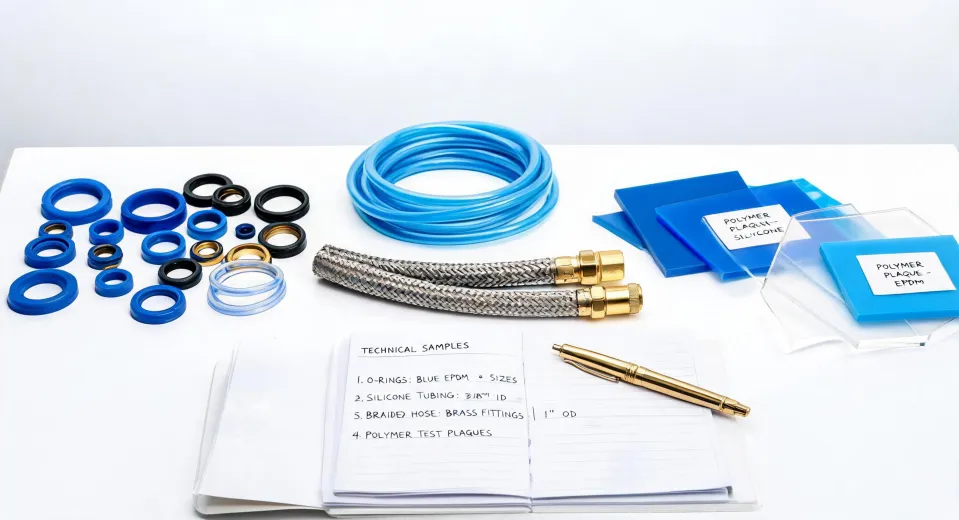
Here's what outsiders don't see. "Trelleborg rubber" isn't a material. It's a brand portfolio covering dozens of distinct polymer compounds—EPDM, NBR, FKM, HNBR, silicone, PTFE, and more. Trelleborg's engineered polymer solutions span everything from O-rings and hydraulic seals to hose assemblies and custom-molded parts. Those are all different materials. "Trelleborg rubber" is procurement shorthand that should never appear on a spec sheet.
The problem with shorthand is that it hides real engineering decisions. EPDM and NBR both count as "rubber" in everyday language, and both are used in industrial sealing. But they fail in opposite directions:
- EPDM is excellent against ozone, UV, and water—but petroleum oils cause it to swell and soften.
- NBR is the opposite: strong oil resistance, weak in outdoor weathering and ozone.
Specify "rubber" without knowing which one you need, and you're not making a choice. You're outsourcing the choice to whoever happens to pick your order. And if that person chooses based on stock availability rather than application, you'll probably get a real material—just not the right one.
The same confusion shows up in "PVC joints." PVC is durable and chemically resistant, which is why it's everywhere in water systems. But a gasket for a PVC joint isn't automatically compatible with PVC. Plasticizers in the PVC pipe can migrate into certain rubber compounds, causing the seal to harden and crack. The correct gasket depends on the fluid, the temperature range, and the pressure rating. None of that appears in a spec that says "rubber gasket."
The Language Problem Behind "PVC Fönster Trelleborg"
Here's a small example that demonstrates a large problem. Type "pvc fönster trelleborg" into a search engine—a real query, Swedish for "PVC windows Trelleborg"—and the results mix local window installers from the town of Trelleborg with the industrial polymer company that shares its name. Same word. Completely different product categories.
And it's not just search engines that get confused. The same imprecision wreaks havoc in procurement.
A former mentor once told me: "Every material name is a hypothesis about a context." PVC isn't just PVC. It's PVC in a window profile, PVC in a pipe, PVC in a cable jacket. Each context implies different additives, different durability expectations, different failure modes.
When I said "Trelleborg rubber seals," I was making a hypothesis about a context I hadn't investigated. The distributor's catalog didn't correct me. Why would it? I'd given them a brand name, and they gave me a product that roughly matched. The mismatch only became visible when the seals were in a real PVC joint, under real pressure, carrying real process water. Then it was very visible.
Clean Hydraulic Hose: The Most Expensive Clean I Ever Approved
In late 2021, a machine went down. Fault diagnosis: contamination caused valve wear. The prescribed remedy: replace the hoses, clean the system, get back to work.
I approved a work order to clean hydraulic hose assemblies before reuse. The technician used a solvent that happened to be sitting on the shop shelf. The hoses looked pristine afterward. Pristine.
The engineer who re-certified the system caught the problem during pre-installation testing. The solvent had attacked the hose's inner tube material. The tube was flaking from the inside—self-generating contamination. The "cleaning" had created the exact failure mode we were trying to prevent.
The cost: $890 in replacement hose assemblies, $350 in labor for a second disassembly round, and three days of production delay. I should have asked the hose manufacturer for the cleaning procedure instead of letting the crew grab whatever was on the shelf.
Is Polyethylene Glycol Plastic? What the Search Snippet Missed
A year later, a new team member came to me with a spreadsheet. One line said "polyethylene." Another said "polyethylene glycol." Were they the same?
They had googled "is polyethylene glycol plastic" and gotten a technically correct but practically useless answer: "PEG is a polymer, but it's generally not classified as a plastic."
Here's the gap. Polyethylene—the plastic—is the stuff of bags, bottles, and pipe insulation. Polyethylene glycol is a water-soluble polyether used in pharmaceuticals, cosmetics, and industrial lubricants. Different chemical families. Not interchangeable. A previous teammate once ordered the wrong release agent based on the name resemblance alone. $320 of material went to hazmat disposal. Nobody learned, and I only found out about it during a root-cause review months later.
The Receipts
Three failures in one row:
- PVC joint gaskets ordered as "Trelleborg rubber" with no compound spec: $1,800 replacement parts + $680 labor and logistics. $2,480 total. Two weeks of reduced capacity.
- Hydraulic hoses "cleaned" with the wrong solvent: $890 hose assemblies + $350 labor. $1,240 total. Three days of downtime.
- Release agent ordered due to "polyethylene" vs. "polyethylene glycol" confusion: $320 wasted plus hazmat disposal fees.
Total: $4,040 documented. The root cause in all three cases was the same—I ordered by category instead of specification. I assumed the supplier would catch me if I were off. Some did, eventually, after the parts arrived.
The Boring Fix
If you want the expensive version of this lesson, keep doing what I did. If you'd rather have the cheap version, this checklist has caught 47 potential errors in the last 18 months:
- Name the material compound, not the brand or category. "Trelleborg" is the manufacturer; "EPDM 70 Shore A" is the material.
- Ask what's NOT specified. My favorite pre-order question: "What are the limitations of the material you're recommending?" A competent supplier should be able to list at least three without hesitating.
- Verify chemical compatibility with the operating environment. For PVC joints, check the gasket material against plasticizer exposure, temperature range, and the specific fluid.
- For hydraulic hose maintenance, get the cleaning procedure from the hose manufacturer. Visual cleanliness isn't a spec; ISO 4406 particle counts are.
- Stop when a material name is unfamiliar. Pull the datasheet before ordering. Google is for definitions, not for purchase decisions.
This fix won't make you look smart. It'll probably make you look overly cautious. But cautious is cheap. A $4,040 education is not.
One caveat: my experience comes from a mid-size B2B operation with predictable maintenance cycles. If you're in food-contact, aerospace, or high-volume manufacturing, your requirements are a different league entirely. The habit—specify instead of naming—should translate. The specifics might not.