My View: The Cheapest Material Usually Isn't the Cheapest Choice
I've managed procurement for a mid-sized chemical equipment company for about six years. Over that time, I've audited roughly $180,000 in cumulative spending on piping, sealing, and sheet materials. And here's what I've come to believe: if you're picking materials like SCH40 PVC pipe or thick plastic sheets purely by unit price, you're leaving money on the table. Honest, I'm not sure why so many procurement folks treat material selection as a commodity purchase. My best guess is they've never had to sit through a line shutdown caused by the wrong plastic.
Let me be blunt from the start: there's no universal best material. There's only the right one for your operating temperature, pressure, chemical exposure, and mechanical load. And the right one often costs more upfront but less over the lifetime. I've seen it play out dozens of times.
Argument 1: The SCH40 PVC Pipe Myth
SCH40 PVC pipe is everywhere in low-pressure water systems. It's cheap, easy to glue, and everyone knows it. But I can't tell you how many RFQs I've received where an engineer specified SCH40 for a line that runs at 140°F – which pushes PVC's max service temperature to its absolute limit. At that point, the pipe softens, joints creep, and you're looking at a $1,200 redo before the six-month mark.
I went back and forth between SCH40 PVC and CPVC for a cooling water line for two weeks. PVC was 40% cheaper per foot. But when I calculated the TCO including expected replacement cycles, CPVC won. That $1,200 redo I mentioned? That was from our pilot line when we tried SCH40. The engineering team thought the temperature would be lower – it wasn't. (Note to self: always verify actual process conditions.)
The lesson: if you're buying SCH40 PVC pipe, make sure your operating temperature stays below 140°F and pressure under 150 psi at room temp. If you can't guarantee that, pay up for CPVC, polypropylene, or even lined steel. It's cheaper in the long run.
Argument 2: Thick Plastic Sheets – Polyethylene Isn't Always the Answer
When people ask “what type of plastic is polyethylene”, I usually say it's a thermoplastic with great chemical resistance and low cost. But it's also soft, prone to creep under load, and not great for high abrasion. I've ordered thick polyethylene sheets (3/8 inch and up) for tank linings and wear strips. Worked fine in some applications. Failed miserably in others.
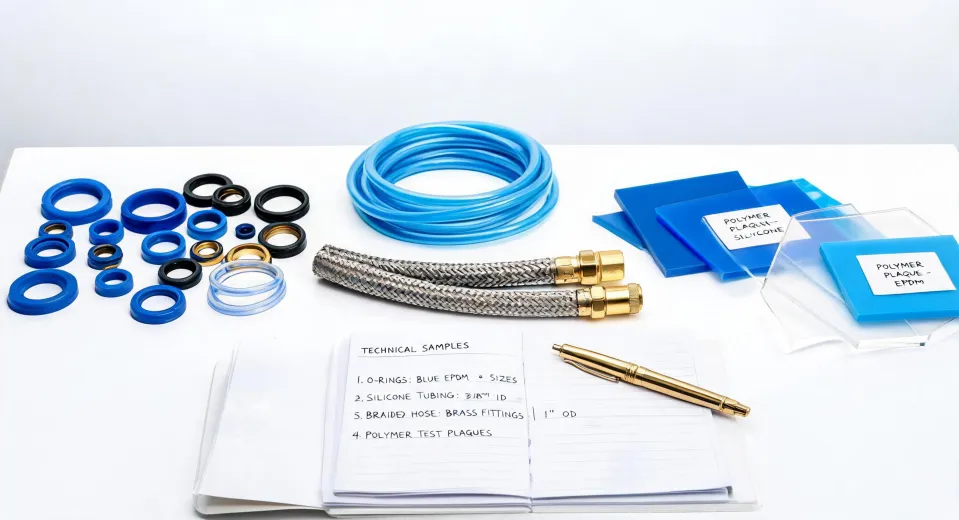
Compare that to engineering-grade thermoplastics like UHMWPE, PTFE, or polyurethane. Or consider rubber sheets – Trelleborg Minnesota Rubber makes EPDM and silicone sheets that handle higher temperatures and more flex. I once compared a 1/2-inch thick HDPE sheet (about $42 per square foot) to a neoprene rubber sheet ($58 per square foot) for a gasket application. On paper, HDPE was cheaper. But after three months the HDPE cracked from repeated thermal cycling. We replaced it with rubber, which cost 38% more but lasted three years.
That decision kept me up at night. I'd approved the HDPE based on price. When the crack appeared, I thought “did I make the wrong call for the whole batch?” We had already installed 60 sheets across two lines. The replacement cost $2,800 in labor alone. Total hidden cost: about $4,200.
Key takeaway: thick plastic sheets save money only when the application fits the plastic's mechanical and thermal envelope. Otherwise, you're just delaying a failure.
Argument 3: The Trelleborg Factor – When Brand Actually Matters
I know – some people roll their eyes when you bring up premium brands. Trelleborg Minnesota Rubber (now Trelleborg Sealing Solutions) has a comprehensive range: from silicone tubing to o-rings, gaskets, and custom profiles. Their prices aren't always the lowest. But I've learned that buying from a company with deep material expertise reduces my risk.
Here's a concrete example. I needed a seal for a chemical pump handling acetic acid. I could choose a generic nitrile o-ring for $0.12 each, or a Trelleborg-sourced FKM (Viton) o-ring for $0.45. The nitrile would swell and fail in about 6 months. The FKM would last 2+ years. Replacing a failed o-ring costs $80 in downtime and labor. Over a 10-year system life, the FKM option saves over $300 per o-ring – even though the unit price is 275% higher.
Now, does Trelleborg have limitations? Absolutely. Their thermoplastic products (like nylon or acetal) might not handle some aggressive solvents as well as PTFE. Their silicone tubing isn't rated for high steam sterilization cycles. I've had to say no to using their EPDM in a concentrated sulfuric acid line – that's a job for PTFE. But that honesty is exactly why I trust them: they'll tell you when their product isn't the right fit.
Countering the Obvious Pushback
“You're just saying this because you work with premium suppliers.” Fair point. But let me show you the math. In Q2 2024, when we switched from a low-cost PVC supplier to a more expensive but technically supported one (Trelleborg offered the CPVC alternative), our initial outlay went up 22%. But over the following 18 months, our total pipe-related maintenance costs dropped 41%. Net savings: $8,400 annually – about 17% of our material budget for that category.
I built a cost calculator after getting burned on hidden fees twice. It accounts for installation labor, expected lifespan, spare parts inventory, and downtime cost per hour. When I run the numbers, the “cheap” option rarely wins.
So, What Should You Do?
I'm not saying never buy SCH40 PVC or thick HDPE sheets. I am saying: before you spec any material, ask yourself what happens if it fails in your specific environment. Then calculate the total cost of that failure, multiply by the probability, and add it to the purchase price. That's your real cost.
For polyethylene, know that it's a semi-crystalline thermoplastic – it won't handle sustained heat over 180°F, and it creeps under constant load. For PVC, treat 140°F as a hard ceiling. And if you're dealing with complex chemical or thermal conditions, call a supplier like Trelleborg Minnesota Rubber and ask for a material recommendation. They might suggest something you haven't considered, and they might also tell you when they can't help – which is a gift of clarity.
Honestly, I've never fully understood why some procurement teams still select materials by unit price alone. My best guess is it's because they haven't tracked the full lifecycle costs. Once you do, the cheaper option almost never looks cheap.
Stop buying the cheapest pipe and sheet. Start buying the right material for your conditions. Your bottom line will thank you.