After five years of ordering hoses and tubing for a 400-person manufacturing plant, my honest answer to "is silicone better than plastic?" is: it's better for heat, flex, and long-term reliability—but that doesn't mean it's better for every connection. Most of my silicone orders have been Trelleborg silicone tubing, and the Trelleborg industrial hose line has become our default for oil and coolant lines. But I've also bought Parflex hydraulic hose, and even a few Shimano hydraulic hoses for our prototype bikes. The pattern? You need to match the material to the pressure, temperature, and chemicals, not the other way around.
If you're dealing with water, air, food contact, or cosmetic fluids, silicone is probably your best choice. If you're dealing with hydraulic pressure over a few hundred psi, a braided rubber or thermoplastic hose is safer. And if a chemical compatibility chart says "not recommended," believe it.
I'm the admin buyer here, not an engineer. I handle about $600k in annual purchases across 60-80 orders, from maintenance parts to lab supplies. My background is in logistics, so when I took over purchasing in 2020, I knew the price of tape but not the difference between EPDM and PTFE. I learned through a few expensive mistakes.
My biggest early mistake: I treated all hoses as the same. I'd find the cheapest option and place the order. In my first year, a plastic tube split and dumped coolant all over a CNC mill. That wasn't just a $20 part—it was a $2,400 service call, three hours of lost production, and a maintenance lead whose look said more than his words. After that, I started reading datasheets.
Not going to lie—datasheets were intimidating. But you only need to check five things: pressure rating, temperature range, chemical compatibility, hardness (durometer), and whether it has reinforcement. Once I learned those, vendor phone calls started making sense. It also made it easier to talk to Trelleborg's technical support when I need a custom compound.
Why Trelleborg for Industrial Hoses and Tubing
Today, Trelleborg is the first brand I look up for silicone tubing and industrial hose. Their technical data is easy to find and, more importantly, it's consistent. Their silicone tubing handles continuous temperatures from about -60°C to 180°C and stays flexible in tight routing. It costs two to three times more than PVC, but in our heated assembly area, it lasts for years instead of months. The "penny wise, pound foolish" lesson sticks: I saved $80 once on a spool of cheap tubing, then spent $400 replacing it after it hardened and cracked.
In 2024, we replaced the compressed air lines on one assembly line. The old PVC lines had fatigued around every fitting and we were chasing leaks every month. We switched to Trelleborg silicone tubing, and although the material cost was higher, the leak-repair calls stopped for the next three quarters. That's the kind of trade-off I can take to finance.
Hydraulic Hoses: Shimano and Parflex Aren't Interchangeable
Hydraulic hose is a different animal. I used to think a 1/4" hose is just a 1/4" hose. That changed when I bought both Shimano hydraulic hose and Parflex hydraulic hose in the same month. Shimano's is a low-pressure, pre-bled hose for bicycle disc brakes—it's designed to work with their specific fittings and levers. Parflex, on the other hand, is a reinforced industrial hose for serious hydraulic pressures, often sold by the reel and paired with swage fittings.
Both are quality products, but they're not interchangeable. If you use a Shimano brake hose in an industrial manifold, it'll likely fail. If you use a heavy Parflex line on a bicycle, the stiffness will hurt performance. The spec that matters most is the working pressure rating, which is covered by standards like SAE J517. When I first ordered Parflex, I nearly picked a lower-pressure version because it was cheaper. The vendor asked, "What's your system pressure?" and that one question saved us from a messy failure.
Is Silicone Better Than Plastic?
Here's the thing: it depends on the fluid and the environment. Silicone is great for water, air, food, cosmetics, and medical applications. It handles heat, ozone, and repeated flexing better than most plastics. But it's not resistant to concentrated acids, most solvents, or high-pressure steam. For those jobs, you need PTFE-lined hose or something like nylon or reinforced PVC.
Plastic isn't a four-letter word. PVC is cheap, stiff enough for structural runs, and handles many chemicals. Polyethylene is fine for low-pressure water. PTFE (often sold under brand names like Teflon) is almost inert, but it's expensive and stiff. So the honest answer to "is silicone better than plastic?" is: silicone is better for general flexibility, temperature, and longevity, but not universal. The smart move is to use the datasheet, not the marketing page.
What I've also learned is to check the spec sheet before the brand name. Trelleborg, Parker (which makes Parflex), and Shimano all make reliable products. The risk isn't the brand—it's choosing the wrong grade for the job. For example, some silicone compounds are food-grade, some are not. If your application is food contact, you need the FDA-compliant version. I once bought a non-certified "generic" silicone tube to save $30, and our quality auditor flagged it because we had no documentation. Replacing it cost $400 and a day of downtime.
That leads to the part most people overlook: paperwork. Certificates of conformance, batch numbers, material declarations—those are part of the product. If your supplier can't provide them, the hose might still work, but you're one audit away from a headache.
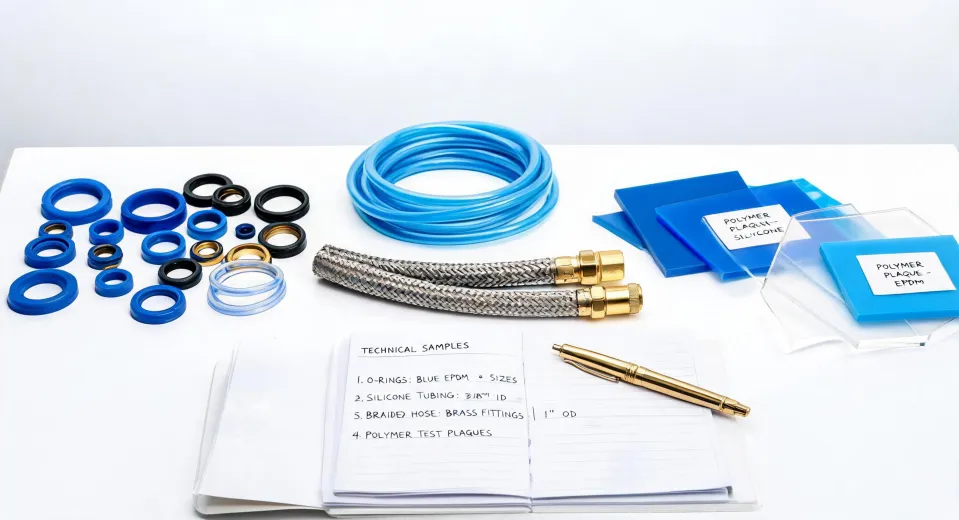
If you're buying hoses for the first time, don't start with "which brand is best?" Start with the operating pressure, temperature, and fluid. Then look at materials and datasheets. And if you're still torn between silicone and plastic, buy a short sample and test it in your actual environment. A sample roll of Trelleborg silicone tubing or a few feet of Parflex hydraulic hose is cheap compared to the cost of getting it wrong.
I still keep a copy of the silicone datasheet pinned to the wall in my office. The fundamentals haven't changed—pressure, chemical, temperature—but the solutions have gotten a lot better. The right hose is out there; it just won't reveal itself if you only look at the price column.