-
Who Should Use This Checklist
-
The Six-Step Checklist
-
Step 1: Define the operating environment before you define the material
-
Step 2: Get the current revision of the drawing or spec
-
Step 3: Compare total cost, not unit price
-
Step 4: Ask for samples, and pay for them
-
Step 5: Compare materials with an application in mind
-
Step 6: Verify packaging, marking, and traceability
-
Step 1: Define the operating environment before you define the material
-
Three Mistakes I Still See
-
Final Note
Who Should Use This Checklist
Over the past six years, I've managed a six-figure annual budget for rubber and plastic components at a 40-person manufacturing company. I've placed sample orders worth $180 and production orders worth $48,000. I've also built a cost tracking spreadsheet that my colleagues tease me about—until it catches a hidden charge.
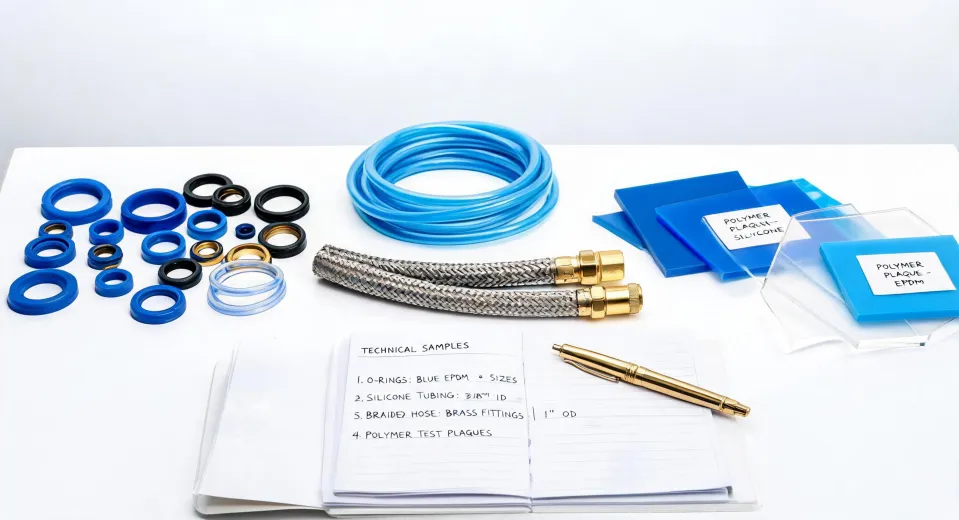
Buying Trelleborg silicone tubing, rubber tiles, silicone pads, or any custom polymer part usually starts the same way: someone sends you a data sheet, or you search for 'TPU cleats vs rubber' and end up in a rabbit hole. This checklist is for buyers who don't have a full-time materials engineer on staff but still need to make good purchasing decisions.
Below is the six-step checklist I use. It won't tell you which material to pick. It will tell you how to compare suppliers without getting burned.
If you're buying one-off rubber tiles for a workspace, or you're procuring Trelleborg silicone tubing for a new product, this applies. Small order doesn't mean sloppy. To be fair, small orders do get deprioritized by some suppliers. That's not a reason to accept weak service; it's a reason to build a short vetting process.
The Six-Step Checklist
Step 1: Define the operating environment before you define the material
The first mistake I watch for is focusing on the material name and missing the environment. Search for 'Trelleborg silicone tubing' and you'll see options. The one I order might not be the one you need. Silicone tubing for a peristaltic pump is not the same as silicone tubing for a drain line. The polymer family is the same; the specification is not.
Ask: What temperature? What chemical contact? Is it flexed? Does it need to be sterilized? Those answers change the shore hardness, wall thickness, and cure system. If you skip this step, you will compare quotes that aren't comparable.
Step 2: Get the current revision of the drawing or spec
From my side, more cost overruns come from drawing version mix-ups than from bad pricing. When a manufacturer quotes a silicone pad, they are often working from a drawing that is two revisions old. If you don't write the rev number on the RFQ, you'll get a quote for the wrong part.
Check the print. Check the tolerance block. Check which surface finish applies. Then write the rev number on every email. This is the step that gets skipped.
Step 3: Compare total cost, not unit price
Compare total cost, not unit price. One of the biggest blind spots I watch for: buyers focus on per-unit price and miss tooling, revisions, logistics, and payment terms. I learned this the hard way in Q2 2024. We had two quotes for a silicone pad assembly. One was 14% cheaper per unit. The other had a higher unit price but included two sample rounds and a mold maintenance allowance. Over 18 months, the 'cheap' option cost us $3,700 more because of a revision charge that wasn't in the original quote.
To make a fair comparison, I use a TCO line: unit price + tooling + minimum order value + shipping + duties + documentation + expected scrap rate. If a supplier won't itemize these, that's a red flag. If you ask me, a supplier that won't itemize a quote is showing you how they'll handle future problems.
Step 4: Ask for samples, and pay for them
If a supplier treats a sample order like a nuisance, remember this: today's small order might be next year's production run. I placed a $200 sample order with a smaller molder in 2022; they are now one of our regular vendors.
Don't apologize for a small order. When you need rubber tiles for a test installation, ask for one full tile and a few cut samples. A hand-cut piece is not enough; you want to see the production process, not just the material.
Also, be careful with quantity. I almost approved a sample order for 10x what we needed because the supplier's minimum unit was a box of 100 and I was typing in the quantity box. Dodged a bullet. I do not mean 'checked twice'—I mean I literally looked at the line three times before clicking.
Step 5: Compare materials with an application in mind
Searching 'TPU cleats vs rubber' is a good starting point, but the answer is never just 'TPU is better' or 'rubber is better.' I have mixed feelings about material comparison articles: they make it look like a spec sheet can settle an application problem. Sometimes it can't.
TPU cleats often resist abrasion and stay flexible in cold conditions. Rubber can provide better wet traction and lower cost. But the real test is how the cleat is attached and what it's going to hit. If you're choosing between TPU and rubber for a conveyor cleat, test the assembled part, not just the raw material.
Per the FTC Green Guides (ftc.gov), environmental marketing claims like 'recyclable' must be truthful and substantiated.
Don't assume 'recyclable' means 'recycled content' or 'biodegradable.' If a supplier markets a rubber tile as 'recyclable,' ask them to substantiate it. That's part of the TCO conversation too.
Step 6: Verify packaging, marking, and traceability
This is the step that sounds boring and saves money. A Trelleborg logo on a package tells you the part came through an authorized distribution channel; it doesn't tell you the lot or cure date. If traceability matters, ask for the lot marking and a certificate of conformance before you place the order, not after.
If color is part of the product—say, a silicone pad with a visible surface—ask about color tolerance. According to Pantone Color Matching System guidelines, a Delta E below 2 is usually considered acceptable for brand-critical colors. You don't need a spectrophotometer for every order, but if a customer rejects a batch because the color is off, that's a real expense.
If you're verifying a Trelleborg logo on a molded part, ask whether it's molded or printed. Molded marks survive longer; printed marks can wear off. This matters for warranty claims.
Three Mistakes I Still See
Treating a small order as a 'test' with no specifications. I get why people do this—they want to be flexible. But a vague RFQ gives you vague pricing. When I audited our 2023 spending, I found that 70% of our change orders came back to specs that weren't documented up front.
Choosing a material because it worked in another product. That's how you get rubber pads that soften in oil or tubing that cracks in UV. Polymer selection is application-specific.
Ignoring the cost of verification. A cheap part with no documentation is not cheap. If you can't trace it, you can't defend it in a warranty discussion.
Final Note
That's it. Six steps, no magic. If you're buying Trelleborg silicone tubing, custom silicone pads, or rubber tiles, or if you're still weighing TPU cleats vs rubber, the process is the same: define the application, compare the total cost, verify the supplier, and keep a paper trail. Small doesn't mean unimportant. It means potential.