
In September 2023, a customer sent me photos of cracked polycarbonate housings. We'd shipped 5,000 units the month before, and the first field failure report landed in my inbox at 7:15 AM. Long, branching cracks running from every screw boss to the edge of each housing. These parts were spec'd for five years of service. They made it five weeks.
I'd chosen polycarbonate over ABS because "PC is tougher." That's the conventional wisdom, and it's true in a narrow, lab-tested sense. What I mean is, I picked the material everyone calls strong without verifying whether impact strength was even the property that mattered. It wasn't. The housings failed from environmental stress cracking, not impact damage. Polycarbonate vs ABS plastic was the question I was asking. It was the wrong question.
I've handled material specification for a mid-size industrial equipment manufacturer for eight years. In that time, I've personally made and documented 14 significant material mistakes, totaling roughly $46,000 in wasted budget. Some of those failures still make me wince. That's why I now maintain our team's material selection checklist. Not because I'm a polymer expert. Because I've earned the scars.
The Surface Problem: We Treat Material Choice Like a Spec Sheet Game
Most people think choosing a plastic is a comparison of datasheets. Strength. Temperature rating. Price per kilogram. Pick the one with the best numbers at the lowest cost. Done.
That approach looks reasonable. It's also how I racked up most of those 14 mistakes. Compare polycarbonate vs ABS plastic on paper, and PC looks like the obvious winner: higher impact strength, higher heat deflection temperature, better clarity. But datasheets are marketing documents with technical numbers on them. They list best-case values, measured in ideal conditions, on the most optimistic sample.
Nobody gives you a datasheet for real service conditions. Nobody tells you what happens when a material sits in a hot warehouse for three months before assembly, then sees -15°C nights, forklift impacts, or intermittent chemical contact. The trap I kept falling into was asking "which material is better?" instead of "which material is better for my specific combination of conditions?"
The Deep Problem: What 14 Failures Taught Me
After mistake number seven, I started a spreadsheet: every wrong choice, the application, the failure mode, the cost. Reviewing those entries taught me more about polymers than any textbook. The failures weren't random. They clustered into patterns.
1. Real Service Conditions Beat Lab Ratings
The plastic pallet failure is a perfect example. I ordered 120 plastic pallets for our warehouse based on a dynamic load rating of 1,500 kg. Seemed generous. But our forklift drivers loaded crates with concentrated point loads, and some pallets spent time in a cold aisle at 4°C. Within nine months, several pallets sagged permanently. The rating said 1,500 kg. It didn't mention that the test assumed evenly distributed loads at room temperature. The datasheet wasn't lying — it just told the part of the story that made the product look good.
2. PVC Supply Is Not a Commodity
Next lesson: PVC supply. I used to think this was simple. Call a supplier, order PVC, done. Then we saved $0.10 per kilogram by switching suppliers, and our tubing started shrinking during production.
PVC is not one material. It's a family of formulations with different plasticizer levels, stabilizer packages, and molecular weight distributions. The new material technically met the datasheet specs, but it sat right at the edge of the tolerance range. And materials at the edge behave differently in production. Put another way, our spec wasn't precise enough to protect us. A $0.10 per kilogram savings turned into $3,200 in scrap and a one-week delay.
3. Color Changes the Physics
Here's a surprise. Color concentrates and additives can alter a polymer's mechanical behavior, not just its appearance. We once switched a sealing component to a different pigment to match a customer's brand color, and the dimensional consistency drifted between batches. If color tolerance matters for your part, the reference standard is the Pantone Matching System; common practice calls for a Delta E of 2 or below for brand-critical colors (like a corporate blue on a visible housing). But Delta E only measures visual difference. It says nothing about how a pigment load affects crystallinity, shrinkage, or impact behavior. Note to self: always re-run dimensional testing when a color changes.
The color wasn't the only variable in that failure, but it was the one we'd changed. That's the pattern I eventually recognized: every material substitution or modification looked harmless in isolation, and each one cost money before we figured out what went wrong.
4. "Recyclable" Claims Need Verification
Environmental claims are another minefield. Per FTC Green Guides, a claim like "recyclable" has to be substantiated. But "recyclable" is not the same as "consistent." We approved a recycled-grade HDPE for a non-critical component and discovered that batch-to-batch variability caused parts to fail dimensional inspection. The recycled material was genuine. It just wasn't consistent enough for our process.
5. Failure Mode Matters More Than Strength
Going back to the polycarbonate housings: PC is strong, but under molded-in stress and certain chemical exposure, it cracks. ABS has lower datasheet numbers, but it tends to deform rather than fracture. For our application, ABS might have been the better choice — even though the numbers said otherwise.
Everything I'd read about premium materials said the stronger option always wins. In practice, after eight years and thousands of parts, I've learned that the best material is the one whose failure mode you can live with, not the one with the most impressive chart.
The Real Cost of Getting It Wrong
Mistakes sound abstract until you put numbers on them. These are the ones I remember best:
- The polycarbonate housing failure: about $12,000 in rework plus a 3-week delivery delay.
- The plastic pallet write-off: 120 pallets, roughly $7,800, plus rental replacements while we waited for better ones.
- The PVC supplier switch: $3,200 in scrap and a week of downtime.
- The recycled HDPE dimension issue: $2,100 in rework across two batches.
That's about $25,000 in direct costs. I want to say the full impact — including engineering hours and expedited shipping — was closer to $46,000, but don't quote me on the exact breakdown. The point is, we could have hired a part-time materials consultant for a fraction of that and still come out ahead.
The event that finally changed how I think about this happened in spring 2024. We missed a customer's launch window because of a material issue I'd flagged months earlier and then overruled myself on. That one hurt. Not just the money. The fact that the warning signs were visible the whole time.
What Finally Fixed It
The fix wasn't memorizing material data tables. It was changing the process from "pick from memory" to "check with someone who knows more."
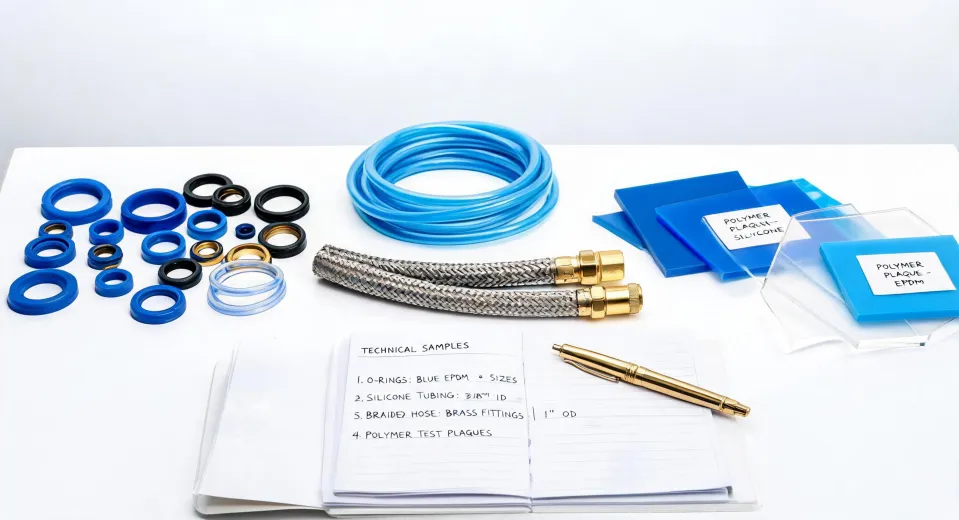
The turning point was the Trelleborg official homepage. I'd always associated Trelleborg with seals and hoses, but their engineering resources cover a much broader polymer portfolio — EPDM, silicone, TPU, PTFE, plus design guidance that applies across all of them. More importantly, their engineers were willing to review our applications and give straight answers. They don't have a material that works for every problem, and they'll tell you when something isn't the right fit. That's rare.
We didn't buy products from every conversation. But the conversations consistently improved our specs. Even when the answer was "you already have a workable material, just change the wall thickness," we saved ourselves a redesign.
The process became a four-step checklist:
- Define the actual service conditions — temperature range, chemical exposures, load type, regulatory requirements. Be honest about what you don't know.
- Send that description to a material engineer before finalizing the spec, not after.
- Test samples under realistic conditions, not just datasheet conditions.
- Document what you learned, so the next person doesn't repeat your mistake.
This worked for us, but our situation was specific: a mid-size company with a small engineering team and fairly predictable ordering patterns. If you have a full materials lab in-house, you may not need an external partner. If you're dealing with a highly specialized application, you might need custom compound development. Your mileage may vary.
Material selection is an engineering process, not a shopping decision. The cost of being honest about that is much lower than the cost of learning it from a field failure.