Ask a materials engineer for “the best” rubber or plastic and they'll probably ask you three questions first. What's the environment? What's the load? What happens if it fails? I run procurement for a mid-sized industrial plant, and I've managed $180,000 in annual materials spend across hoses, seals, sheets, and custom parts. Over the last six years, I've had plenty of quotes side by side—and plenty of bad decisions too. The honest answer is there isn't a universal winner. But there is a way to think about it. Basically, a decision tree.
Four paths, one problem: matching material to duty
In my experience, most material selection questions fall into one of these scenarios:
- Outdoor or chemical exposure—think UV, rain, ozone, mild acids.
- Abrasion and impact—the stuff that gets dragged, bumped, and worn.
- Quality and traceability—where a quiet, cheaper part may cost you big later.
- Not sure? Jump to the last section. I'll give you a checklist.
Scenario A: Outdoor and chemical exposure
If your part is a seal, gasket, hose, or cover that lives outside or near chemicals, don't reach for the cheapest plastic sheet. This is where EPDM rubber earns its keep. EPDM handles ozone, UV, water, and a surprisingly wide temperature range better than most polymers. It's a workhorse for weatherstripping, hose covers, and valve seals.
What about polypropylene in the same environment? PP is tough, cheap, and has good chemical resistance in many acids and solvents. But it's not an elastomer; it won't bounce back like EPDM. What you'll often see in industrial products is a combination of EPDM and polypropylene—the EPDM gives flexibility and weather resistance, the PP adds dimensional stiffness. That's a common composite for automotive and industrial profiles, and it's genuinely good at what it does.
For flat, structural panels, corrugated PVC sheets get a lot of attention. They're lightweight, cheap, and easy to cut. Honestly, for indoor partitions or low-UV applications, they're a no-brainer. But here's what I learned the hard way: PVC gets brittle in cold weather and UV breaks down the plasticizers over time. I once chose corrugated PVC for chemical-plant overflow covers because the quote was 40% lower than the rubber alternative. Two winters later, we replaced them. The TCO math was embarrassing, and the plant manager hasn't let me forget it.
What most people don't realize is that the “same” PVC sheet comes in different grades. Recycled or lightly stabilized sheet is cheaper up front and fades or cracks much faster. If a supplier can't show the stabilizer system or test data, that's a red flag.
One more thing: if someone markets a material as “green” or “recyclable,” per FTC Green Guides the claim has to be substantiated. Don't be shy about asking to see the evidence. Sometimes it's a sales pitch, not a spec.
Scenario B: Abrasion and impact
When the part is going to be rubbed, slammed, or scraped, polyurethane changes the conversation. Compared to ordinary thermoplastics—PVC, HDPE, polypropylene—PU has far better tear strength and abrasion resistance. Honestly, it's not even close in heavy wear.
I'm not dismissing plastic. For light sliding surfaces, guides, or low-cost enclosures, HDPE or PP is perfectly fine. Plus, thermoplastics are easier to weld, machine, and recycle. But in high-wear service, plastic parts fail faster, and the replacement cost—downtime included—usually dwarfs the initial price difference.
Let me give you a real example. We lined a vibratory feeder chute with HDPE; it cost about $700. It wore through in nine months. We replaced it with a PU liner at $1,900. Eighteen months later, the PU liner still had 70% of its thickness. In that same window, we would have replaced the HDPE twice more. That's a 17% cheaper material becoming a 200% more expensive operating cost. That's why I track TCO, not unit price.
That said, PU isn't perfect. Some grades don't like hot water or sustained heat, and certain polyethers hold up better in hydrolysis than others. If you're choosing between polyurethane vs plastic, think about temperature and fluid exposure first. The question isn't “which is stronger?” It's “which failure mode is cheaper for my specific machine?”
Scenario C: Brand, logo, and traceability
When a failed part can stop a production line or create a safety hazard, “equivalent” isn't good enough. This is where a supplier like Trelleborg matters, and where the logo on the box is more than decoration.
In the sealing world, you may see the Trelleborg name alongside legacy names like Minnesota Rubber in North America. If a data sheet has both names, that's a signal of decades of rubber formulation experience, not a generic import. Trelleborg is one of the larger engineered polymer companies globally, and their product lines cover everything from O-rings to hoses to custom molded parts.
But remember: logos can be faked. Genuine Trelleborg packaging should have a crisp logo, material compound code, and batch number. If the logo looks faded, the print is blurry, or there's no lot number, I'd treat it as a warning sign. It takes one minute to check the part number on Trelleborg's site or call their support. That minute is cheap compared to the cost of an unplanned shutdown.
A few years ago, I was tempted by a “brand-equivalent” seal at 30% off. It looked close in the photo. It was not close in performance. That 30% saving turned into a $1,200 cleanup and redo after the seal swelled and leaked. The most frustrating part: the vendor never admitted the compound was different. Since then, our procurement policy requires source verification for anything critical.
Here's something vendors won't tell you: the unofficial “same compound” may contain regrind or filler, which you can't detect from a catalog photo. The OEM logo is one form of traceability—but only if you verify it.
How to decide which scenario you're in
If you're not sure whether you need EPDM, polypropylene, polyurethane, or a verified branded product, work through this checklist:
- What's the environment? Add chemical, temperature, and UV exposure to the spec list. No guesswork.
- What's the failure cost? If a failed part means line stoppage or safety risk, lean toward a traceable supplier like Trelleborg.
- Is it wearing out now? Track the replacement history. If parts are replaced more often than expected, a higher-cost PU or EPDM grade often pays for itself.
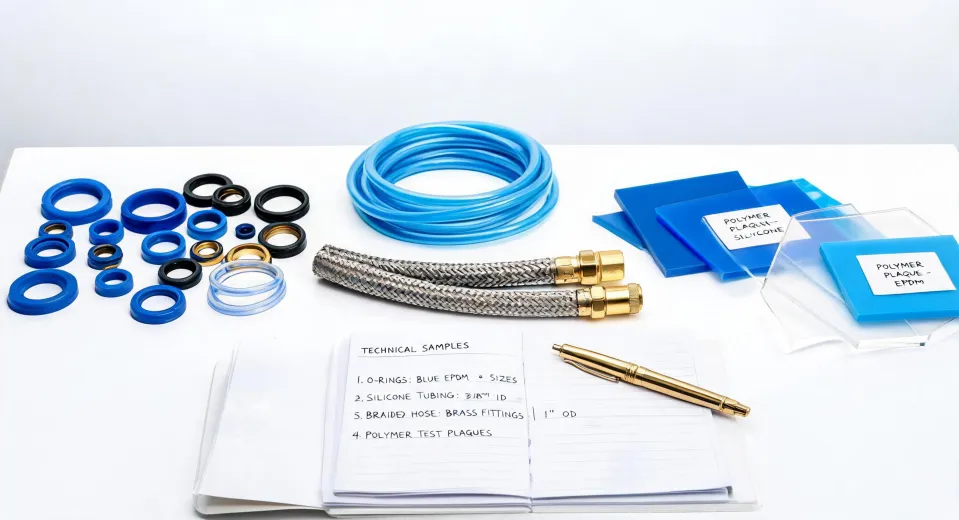
- Ask for data. A reputable manufacturer will share technical datasheets and, if needed, samples. If they can't, that's a deal-breaker, not a price discount.
Bottom line: there's no “best” material, only the best match for your machines, your site's conditions, and your risk tolerance. Cost is not the same as price—it includes the hours of downtime, the labor to reinstall, and the headache of explaining the failure to your boss. Take the extra 20 minutes to calculate total cost of ownership. That habit has saved my team more than any discount ever could.