If you've ever typed best rubber air hose into a search bar, pressed Enter, and clicked Buy without checking the material data sheet, please keep reading. I learned this lesson in a cold maintenance corridor in February 2023, and it cost my customer about $9,600 before the line ran again.
I have worked in Trelleborg's industrial component support group for seven years. Before that, I spent four years doing plant maintenance. I keep my own mistake log—not to punish anybody, but because rubber and plastic failures repeat themselves. As of early 2025, I have documented 47 significant material mix-ups. This one is the first case I show new engineers.
It started with a very confident purchase
A customer called us after a liquid filling line developed air leaks only six days after new hoses were installed. The maintenance manager was not in a good mood. He told me, “I bought the best rubber air hose I could find. It has a 300 psi rating and brass fittings. How is this my fault?”
I asked him to send a photo, then a sample of the failed cover. The tube looked fine, but the outer cover had deep cracks. It had been exposed to an ozone-based sanitizer used during daily washdown. Ozone can be brutal to rubber compounds that are not formulated for it.
“What material is the cover?” I asked.
Silence.
He read the product listing again. It said “rubber air hose.” That's all.
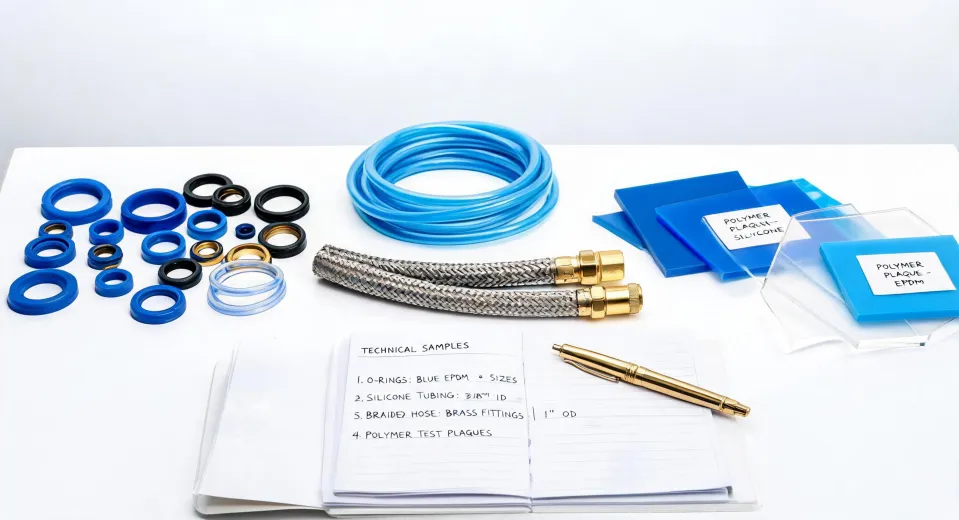
That whole conversation was one of those contrast moments I now use in training. When I compared the customer's failed cover with a Trelleborg EPDM sample side by side, they looked almost the same to the eye. The difference only showed in the data sheet: EPDM is rated for ozone, hot water, and outdoor weather. The failed cover was not. The manufacturer's label said “rubber.” The actual compound was never disclosed.
It's tempting to think that rubber is rubber. It is not. NBR, SBR, EPDM, silicone, and fluororubber are all called rubber, but they behave differently around oil, ozone, heat, and chemicals.
We replaced the failed hoses with a Trelleborg industrial hose selected for the washdown environment. The specification listed the cover polymer, the temperature range, and the test basis for the pressure rating. The replacement hose cost more than the internet prize winner. But the first failure had already cost roughly $9,600 in lost production, rush freight, and labor. The data sheet made the expensive hose look cheap by comparison.
Here is what you need to know about the phrase “best rubber air hose”: it is a marketing sentence, not an engineering specification. Per FTC guidance, marketing claims should be truthful and backed by evidence. But even a true claim only applies to the conditions it was tested under. A hose can be “best” for dry compressed air and terrible for ozone.
Two more mistakes I found before lunch
While the customer waited for the new hose order, I asked to see the drawings for the rest of the machine. We found two more issues.
The first was a clear safety window. The drawing called for Lexan polycarbonate plastic. The installed panel was acrylic. Both are clear. Both are plastics. But they are not interchangeable.
Most buyers focus on thickness and price and never think about impact behavior. Lexan polycarbonate plastic is specified when you need high impact resistance. Acrylic is more likely to crack or shatter under impact. Somebody in the supply chain decided that “clear plastic” was a good substitution. No one asked the engineer.
That was not a theoretical issue. A plastic guard on a liquid filling line can get hit by a falling container or a maintenance tool. If it breaks, the result can be sharp fragments near an operator.
The second issue was under the compressor area. Someone had used 1in PVC pipe to build a drip leg for the compressed air system. On a plumbing system, 1in PVC pipe can be perfectly fine. But in compressed air service, a crack does not leak slowly; the stored energy inside the pipe can turn it into shrapnel. The pipe had a pressure rating printed on the side, but that rating was for water at 73°F, not for repeated air pressure cycles, impact, or compressor oil.
I am not saying every piece of 1in PVC pipe is dangerous. I am saying the label alone doesn't tell you enough.
If this sounds like obvious stuff, good. But almost every mistake I document comes from the same habit: choosing a material category by its appearance instead of its specification.
What I changed in my own checklist
The fix wasn't rocket science. It was discipline:
- If a drawing says Trelleborg EPDM or Lexan polycarbonate plastic, don't substitute without an approved material comparison.
- Before buying any rubber air hose, ask for the polymer family of the tube and cover. “Rubber” is not an answer.
- If a component will be exposed to cleaning chemicals, ozone, oil, or heat, compare the chemical compatibility chart, not the price tag.
- For pipe, check whether the material is approved for the fluid, temperature, pressure, and mode of service.
I'd rather spend ten minutes asking questions that make me sound inexperienced than write a root-cause report later. An informed customer asks better questions and makes faster decisions. That's not just a slogan. It's the difference between a $40 hose and a $9,600 mistake.
Bottom line? The next time somebody tells you they found the best rubber air hose, ask them one question: best for which environment? If they can't answer, call a supplier who can.
Take it from someone whose mistake log now has 47 entries: reading the data sheet first feels boring. Replacing a failed component after a line shutdown feels much worse.