If you are an office administrator, a procurement assistant, or someone who just got handed the job of sourcing industrial components—like O-rings, hoses, or plastic parts—this is for you.
You have probably already found the Trelleborg official website, but you are staring at technical datasheets and wondering: Is this EPDM actually the right spec for our application? Is this supplier authorized? And how do I not get burned by a rogue distributor?
I have been managing these orders for a mid-size manufacturing firm since 2020. I handle about 60-80 orders annually across 8 different vendors. I have seen the good, the bad, and the supplier who couldn't provide a proper invoice. Here is a 4-step checklist I use to validate every Trelleborg-related order. It is designed to save you time and keep your internal stakeholders happy.
Step 1: Verify the Source—Is It a Real Trelleborg Channel?
The first thing I do is check the source. The Trelleborg official website has a dealer locator tool. I use this every single time. If someone claims to be an authorized reseller but isn't listed there, that is a red flag.
What I do:
- Go to the official site and use the "Where to Buy" or "Distributor Locator" feature.
- Cross-check the domain name. I have seen fake sites using names like "trelleborg-supplies.com" that look official but are not.
- Call the distributor and ask one technical question about the product. If they cannot answer it, they are likely a middleman without real Trelleborg support.
I learned this the hard way. In 2022, I ordered "genuine" rubber hose from what looked like an official site. It was a reseller who had purchased overstock from a failed project. The product worked—but the warranty was null. Now I check.
Step 2: Match the Material to Your Application—Don't Guess EPDM vs. Silicone
This is where most buyers get tripped up. You might be looking for Trelleborg EPDM because that is what your engineer specified. But EPDM is not a one-size-fits-all material. There are different hardness grades, temperature ranges, and compression set values.
The question everyone asks is: "Is this the right material?" The question they should ask is: "Is this the right grade of that material for my environment?"
My checklist for this step:
- Get the datasheet. Do not rely on the product title alone. Look for the material specification code (e.g., EPDM 70 Shore A).
- Compare with your application. Does it need to withstand oil? EPDM is poor with oils. If your application involves petroleum, you need HNBR or FKM.
- Ask about certification. For regulated industries (food, water, medical), you need FDA, NSF, or USP Class VI compliance. Trelleborg EPDM can offer these, but not all grades do.
I once ordered what I thought was standard PVC products for a lab. It was PVC, but it was general-purpose, not medical grade. The project was delayed by 3 weeks while we re-ordered. The cost of that mistake was not the $150 for the parts—it was the $4,000 in lab downtime.
Step 3: Calculate the Total Cost—Not Just the Unit Price
Here is where my personal philosophy kicks in. In my experience, the cheapest option is rarely the most cost-effective. When I look at a quote for PVC products or rubber seals, I do not just look at the per-unit price.
To be fair, budgets are real. I get why people look for the lowest number. But from my perspective, the hidden costs are what kill you.
What to look for:
- Minimum order quantities (MOQs): A cheap unit price with a high MOQ means you are storing inventory you may not need.
- Shipping and lead times: A $5 gasket from a cheap supplier that takes 4 weeks is worthless if you need it in 2. A $6 gasket from an authorized Trelleborg distributor that arrives in 3 days is worth the extra dollar.
- Return policy: If the material is wrong, can you return it without a restocking fee? That hidden fee can eat your savings.
I always ask suppliers for a total landed cost (TLC) quote. This includes shipping, duties, and any handling fees. One supplier I used showed a great price, but the shipping added 35% to the total. The 'expensive' official distributor was cheaper overall.
Step 4: Validate the 'Weird' Request (Like PVC Bodysuits or 'Is Rubber Plastic')
This step is for the oddball requests. You might be asked to source PVC bodysuit material (for industrial protective gear, not what you think), or someone in your office might ask: "Is rubber plastic?"
Most buyers would ignore this. I do not. I ask clarifying questions because the answer tells me what the user actually needs.
How I handle it:
- For PVC bodysuits: This usually means flexible PVC sheeting for chemical splash protection. Do not order standard PVC. Look for flexible PVC blends (like PVC/Nitrile) with chemical resistance data.
- For the "Is rubber plastic?" question: The technical answer is no. Rubber is an elastomer; plastic is a polymer that is not inherently elastic. But I have learned not to be pedantic. The user might actually be asking: "Can this part flex and return to shape?" If they need a flexible seal, they might need a TPE or silicone, not a rigid plastic. I use this question to guide them to the right material family. Trelleborg has a huge portfolio—from rigid HDPE to soft silicone—so the right product is probably there. You just need to ask the right first question.
This step has saved me from ordering the wrong product at least twice. It is the step most online guides skip, but it is the most practical one.
Notes & Common Mistakes
Avoid these pitfalls:
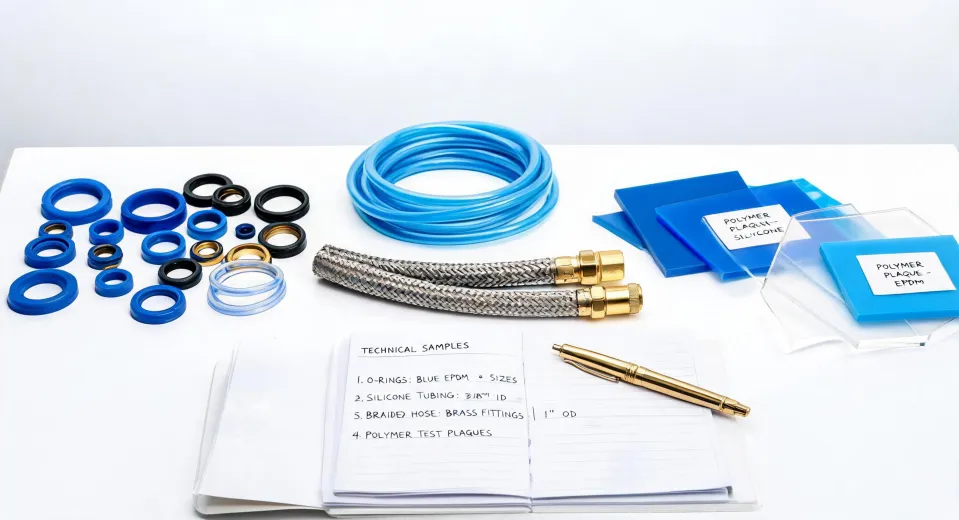
- Don't trust a photo. I have seen "authentic Trelleborg EPDM" O-rings shown with a Trelleborg logo in the picture, but the actual shipment had no branding. If the product does not match the visual, delay the payment.
- Don't skip the invoice check. If a supplier cannot provide a clear, itemized invoice with a valid business address, your finance department will reject it. I rejected a $2,400 expense once because the vendor sent a handwritten receipt.
- Don't assume 'PVC products' are all the same. PVC can be rigid (for pipes) or flexible (for tubing). It can be UV-stabilized (for outdoor use) or not. Always specify the use case.
Per the Federal Trade Commission (FTC) guidelines on advertising substantiation (ftc.gov), any claim a supplier makes about a product—like "food-grade PVC" or "chemical-resistant EPDM"—should be backed by documentation. If they cannot produce a datasheet or a certificate of compliance, that is a warning sign.
I hope this checklist helps you avoid the mistakes I made. It is not about being perfect—it is about being thorough on the front end so you do not have to clean up a mess on the back end.