
-
Who this checklist is for (and who it isn't)
-
Step 1: Define the environment, not just the part
-
Step 2: Verify the material spec against the physical sample
-
Step 3: Confirm the hardness (durometer) for rubber parts
-
Step 4: Check the packaging for plastic components
-
Step 5: Understand what you're asking about
-
Things I still have to watch out for
Who this checklist is for (and who it isn't)
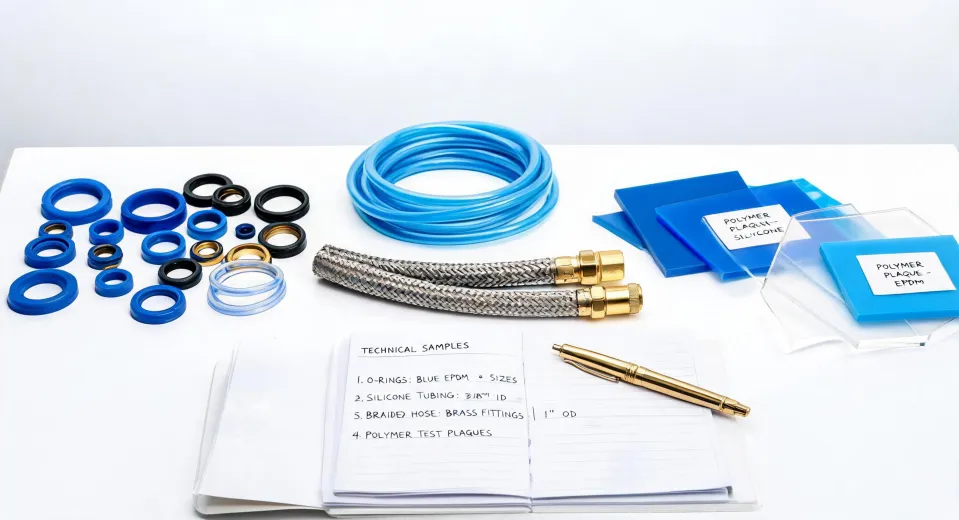
If you're responsible for sourcing industrial hoses, rubber seals, or custom plastic parts, you've probably inherited a few "good enough" suppliers. This checklist is for anyone who wants to move beyond that. It's for the engineer who's tired of premature failures, the purchasing agent drowning in specs, and the maintenance manager who just wants a hose that lasts longer than a quarter.
This isn't a guide for ordering standard office supplies or commodity packaging (like wholesale plastic bags). If that's your world, you can stop here. For the rest of us dealing with engineered polymer solutions—from Trelleborg industrial hoses to a specific polyethylene plastic board—this is based on the mistakes I've made so you don't have to repeat them.
I'm a materials engineer who's been handling industrial component orders for about 8 years. I've personally documented 12 significant specification errors, totalling roughly $14,000 in wasted budget. This list has caught 47 potential problems in the last 18 months. Here are the 5 steps I never skip now.
Step 1: Define the environment, not just the part
In my first year (2017), I ordered a batch of standard rubber hose for a chemical transfer application. It looked fine on paper. The hose was the right diameter and pressure rating. I specified "EPDM" like the old P.O. said. The result was a $3,200 mistake—swelling, cracking, gone in 3 months.
The lesson? Don't just specify a material. Specify what it needs to survive.
- Temperature range: Continuous and peak. I once ignored a 30-second steam cleaning cycle that killed a silicone gasket rated for high heat. The peak temperature exceeded what the continuous rating could handle.
- Chemical exposure: Is it contact, splash, or vapor? EPDM and silicone handle different things. A diluted acid at room temperature is very different from a concentrated one at 150°F.
- Physical wear: Abrasion, flex cycles, vacuum. A hose on a moving robotic arm needs different flexibility than a static transfer line.
I now send a one-page "operating condition" sheet to every supplier before asking for a quote. It saves time and prevents the wrong material selection.
Step 2: Verify the material spec against the physical sample
Everyone warned me about this. I didn't listen. The overconfidence caught up with me when I signed off on a "PTFE" (polytetrafluoroethylene) sheet based on the data sheet alone. It was supposed to be a high-purity grade for a pharmaceutical application. The part arrived, looked right, and we installed it. It failed within a week.
Turns out, "PTFE" is a broad category. And a polyethylene plastic board looks deceptively similar to PTFE if you're just looking at a white, semi-flexible sheet. The supplier had substituted a lower-grade PTFE (or re-grind) that didn't meet the purity spec. It looked fine on my screen. But on-site, the contamination was obvious.
Here's my rule now: for every new material (PTFE, UHMW, PEEK, etc.), I request a small sample piece or a certified material test report (CMTR). I don't just trust the label. If the supplier hesitates, that's a red flag. I learned this the hard way—that mistake cost $890 in redo plus a 1-week production delay.
Step 3: Confirm the hardness (durometer) for rubber parts
This is the step most people forget, and it's the one that bit me the hardest. I once ordered 1,000 O-rings from a supplier (not Trelleborg specifically, but a general distributor). I specified "Nitrile 70 Shore A" on the order form. The price was great, so I approved it without double-checking.
The problem? The supplier interpreted "70 Shore A" as a minimum, and delivered rings that measured 75-80 Shore A. They worked, but they were too hard for the application. The seal didn't compress properly, and we had leaks in 20% of the assemblies. The cost wasn't just the parts—it was the re-work and the field service calls.
Now, I always include a durometer range (like 68-72 Shore A) and request a test report from the batch. For critical applications, I also ask about compression set. A soft part that won't bounce back is just as bad as a hard one.
This is particularly important when sourcing Trelleborg rubber products or generic equivalents. The brand name often implies a specific quality level, but if you're buying from a secondary distributor, you need to verify. I don't care if it says "OEM spec" on the box—I want to see the test data.
Step 4: Check the packaging for plastic components
This seems basic, but I've messed it up twice. Once for a batch of polyethylene plastic board used as a liner, and once for a bulk order of wholesale plastic bags used as component packaging.
For the plastic board, I specified dimensions but not edge finish. The boards arrived with sharp, unfinished edges that had to be ground down on-site. That was a 2-day delay and an extra $600 in labor. The lesson: include edge finishing requirements (radius, deburring, etc.) in your spec.
For the plastic bags, I assumed "standard" would work. It didn't. The bags were too thin for the sharp components we were packing, and they tore during handling. The supplier (a wholesaler) had their own definition of "heavy duty." Now I specify material thickness (mil), dimensions, and a minimum tear strength. I also request a sample roll before approving a full production run. This small step has saved me from three potential packaging disasters this year alone.
Step 5: Understand what you're asking about
One of the most common questions I get from junior engineers is, "Is PTFE plastic?" The answer isn't as simple as yes or no, but it matters for sourcing. PTFE is a fluoropolymer, which behaves like a plastic in many ways (it can be molded, machined, and formed). But it's not a thermoplastic you can injection mold easily—it's a thermoplastic, technically, but it's processed more like a powder metal.
This matters because if you ask a general plastics supplier for a "plastic PTFE sheet," they might quote you a polyethylene or polypropylene sheet instead. The price looks great, but the chemical resistance and temperature range are completely different.
So when you're sourcing a specific material, learn the two or three questions that separate it from similar materials.
- For PTFE: Ask about the filler (virgin vs. glass-filled vs. carbon-filled). Ask for the density (virgin PTFE is about 2.2 g/cm³).
- For polyurethane hoses: Ask about the hardness (Shore A vs. Shore D, which changes flexibility).
- For silicone rubber: Ask about the durometer and the tear strength. Not all silicone is food-grade.
This gets into chemistry territory, which isn't my expertise. I'm not a polymer chemist. What I can tell you from a procurement perspective is: don't assume your supplier knows what you mean when you say "PTFE" or "polyethylene."> Be painfully specific.
Things I still have to watch out for
This checklist is accurate as of early 2025, but the industrial materials market changes fast. Raw material costs fluctuate, and suppliers switch formulations without telling you. I've had a "same product" order fail because the supplier changed their compound to save money.
One more thing: be careful with budget vendors for engineered products. I'm not saying they're always bad, but I've had more success building long-term relationships with established brands like Trelleborg for critical applications. The price is higher upfront, but the specification support and consistency reduce total cost. For non-critical items (like some plastic bags or basic gaskets), speed and price matter more. Know which is which.
And if you're asking "is PTFE plastic" to decide if a plastic welding technique will work—the answer is no. PTFE doesn't melt like a typical plastic. You need a different joining method. That's a lesson for another day.