
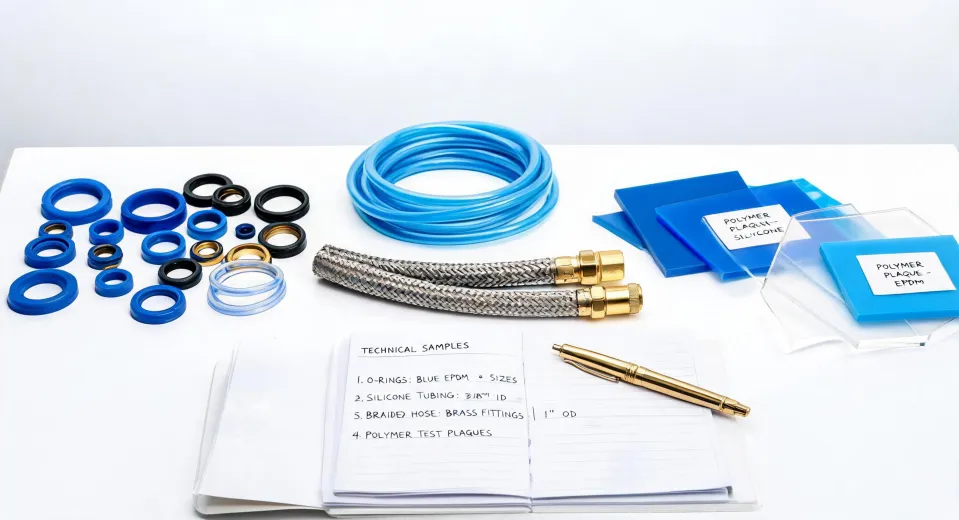
It was 3:47 on a Thursday afternoon in March 2024 when the phone rang. I know the time because I was about to walk out for a dentist appointment, and I remember thinking: whatever this is, it is not going to be quick.
I was right.
The caller was a production manager at a PVC window fabrication plant. They extrude PVC frames for residential windows, and their compressed air system had just failed: the discharge hose between the compressor and the header had burst—split lengthwise, the whole run, in a way that told you this had been building for a while. It also took the rod seal on the pneumatic feed cylinder with it.
Now the line was down, 1,200 window frames were due Monday, and the manager wanted to know exactly how fast we could move.
In my role coordinating rush orders at an authorized Trelleborg distributor, I've handled 200+ emergency requests in eight years, including same-day turnarounds for manufacturing clients. But this one stacked three problems on top of each other: a hose, a fitting, and a replacement seal. None of them were in the same warehouse.
The Best Air Hose for an Air Compressor Is Not a One-Line Answer
Let's start with the hose, because that's the part that actually broke.
The client runs a 25-horsepower screw compressor at 125 psi, feeding a manifold that supplies the whole floor. The burst line was a nine-foot section from the compressor outlet to the header. It was a PVC hose, and it had gone stiff and brittle—probably from years of heat cycles on one side and cold nights on the other. PVC gets hard when it's cold. Hard PVC plus 125 psi of air equals the kind of split I saw in the photo they texted me.
So what is the best air hose for an air compressor? In my experience, it depends on what part of the system it's serving. For a short whip from a drop to a tool, a lightweight polyurethane hose is great. But for a discharge line carrying the full output of a compressor, I want a rubber EPDM hose with a working pressure at least 1.5 times the system's relief setting. We spec'd a Trelleborg EPDM air hose rated at 300 psi working pressure—tested to ISO 2398, the standard for rubber hoses for compressed air—with textile reinforcement for the flexing and temperature swings. Their old PVC hose was rated at 150 psi, which looks fine on paper for a 125 psi system, until you factor in fatigue and cold embrittlement. It's not the material's fault; it's misapplication.
I'm not saying PVC has no place in compressed air. For a light shop setup, it's fine. But for a production line running 16-hour shifts, pay the small difference for EPDM. That is not a sales pitch; it's math.
The PVC Nipple That Almost Cost Us the Whole Order
They also needed a nipple—a short threaded fitting—to reconnect the hose to the compressor manifold and the air treatment unit.
This is where the order went sideways.
I asked, "so that's a 1/2-inch NPT nipple, yeah?" The client said, "yeah, standard." So I sent a 1/2-inch NPT nipple.
It didn't fit.
What they actually had was a 3/8-inch BSP port on the dryer. NPT is a tapered pipe thread. BSP is parallel. They look similar at a glance, which is exactly the trap. When they threaded it in, the engagement was wrong, and it leaked instantly.
I said "1/2-inch NPT." They heard "the right one." We were using the same word but meaning different things—a classic communication failure—and it cost us six hours and the rest of the afternoon. The replacement part was a $12 fitting. The time was not.
Since then, I ask for the port size on both ends of any fitting, out loud, every single time. Feels like overkill. Until it's not.
And the Air Hose Dryer Nobody Mentioned
Here's what I almost missed entirely.
In the photos of the burst hose, the inside was coated with an oily, wet sludge. That's compressor oil carryover mixed with condensation. The client had an air dryer installed—a refrigerated unit right after the compressor—but the bypass valve was stuck open. Water was blowing straight through into the whole pneumatic system.
In my opinion, an air hose dryer is not optional on a production line that runs cylinders all day. Water destroys seals, erodes valve seats, and makes tool performance erratic. They'd been chasing intermittent faults for weeks, and the root cause was humidity they were feeding directly into their equipment.
We added a rebuild kit for the bypass valve and a coalescing filter to the order. I'm not 100% sure whether the valve failed from age or from a pressure spike when the hose burst—the sequence was chaotic enough that nobody audited it. But the symptom was textbook, and the fix was cheap. That's the thing about diagnosing from experience: you learn to check the boring parts first.
Finding the Right Trelleborg Window Seals in the Catalog
And then there was the problem that shows up in searches as "pvc fönster trelleborg": the window seals.
Every PVC frame the plant makes takes a glazing seal—a co-extruded EPDM bulb profile that sits between the glass and the frame. The existing profile was a Trelleborg product, but it was in a different regional warehouse and was the critical path. Without it, every window they assembled was one season away from leaking.
The custom cross-section would have taken two weeks to extrude. Two weeks. The line would have been dark.
So I opened the Trelleborg catalog and found the closest standard bulb profile: same EPDM, same 60 Shore A hardness, slightly different compression range. Then I spent 45 minutes on the phone with the plant's engineer, walking through the dimensional drawing. His verdict: "it'll probably fit."
Probably.
We had two hours to decide before the next-day freight cutoff. Normally I'd want a sample and a test fit. There was no time for that. I approved it—based on the catalog dimensions, the engineer's gut, and the fact that the alternative was a dark plant.
And then I did the thing I always do after a big call: I second-guessed myself. What if the compression range was wrong? What if the corner joints didn't seal? The fourteen hours between that order and the morning delivery were not relaxed.
The moment it paid off
At 6:02 AM the next day, the plant manager texted: "Seal's in. Fits. Restarting."
I let out a breath I didn't know I was holding.
What the Rush Order Actually Cost
The emergency freight was roughly $600 extra: overnight shipping on the hose and seals from two warehouses, plus the small parts sent via USPS Priority Mail Express, which beat ground on that route by a full day. For reference, USPS prices adjust a couple times a year—current rates are on usps.com/stamps—and the flat-rate envelope was about $31 then. Small money, big peace of mind.
The alternative, as the purchasing director reminded me on the next quarterly call, was a plant down for a week. They shipped all 1,200 frames on Monday.
Quality is not just in the product. It's in the experience of the product arriving on time, fitting, and working.
Here's the lesson I keep coming back to. The client didn't remember the hose, the seal, or the price. They remembered that a human being answered at 3:47 PM and made the problem smaller. That $12 PVC nipple almost cost us all of it—not because it was expensive, but because a missing "which thread?" question can sink a $15,000 order and a reputation, at the same time.
If You're in This Situation
A few things I do differently now, after this and the other emergencies:
- Ask for dimensions twice. Port sizes, thread types, pressure ratings, lengths. Out loud. Every time.
- Photograph the old part. The oily sludge inside that burst hose told us more about the system than the failure itself.
- Use the catalog. The Trelleborg catalog has cross-section drawings, tolerances, and application notes for seals and hoses. It's a decision tool, not a coffee-table book.
- When you hear "probably fits," spend the extra 45 minutes checking dimensions. It's the difference between a story and a disaster.
One caveat: my experience is based on about 200 rush orders in industrial distribution, mostly with EPDM, NBR, and polyurethane products. If you're in a different industry, or your facility runs something exotic, your results might differ. But the lesson is usually the same.
The part is only half the job. The other half is the person on the other end of the phone.