In the last five years, I've coordinated more than 200 emergency orders for industrial rubber and plastic components. Every call starts the same way: a stressed buyer, a tight deadline, and a conviction that the problem is delivery speed.
Most of the time, they're wrong.
Here's the opinion I've landed on after years of triaging these situations: speed isn't the bottleneck. The material specification is. And until more procurement teams understand that, they'll keep paying rush fees for problems that were never about logistics in the first place.
What Most Buyers Get Wrong About Trelleborg O-Rings
O-rings are the most common component I source on an emergency basis. They're also the most misunderstood. When a machine is down and production is stalled, the instinct is to grab whatever is in stock and ship it fast.
I remember a food-processing plant that called in March 2024, around 2 PM. They needed 500 Trelleborg O-rings by the following morning. Standard nitrile, they said. “That's what we've always used.”
I asked what the O-rings would be in contact with. A caustic sanitizer used in their washdown line. Nitrile doesn't hold up to that chemistry. It swells, it hardens, it cracks. Period.
We spent two hours pulling the correct compound data and shipping the right material instead. The client thought that was a delay. I thought it was the fastest part of the whole transaction. Because if we'd sent nitrile, the seal would've failed within weeks—probably during a production run.
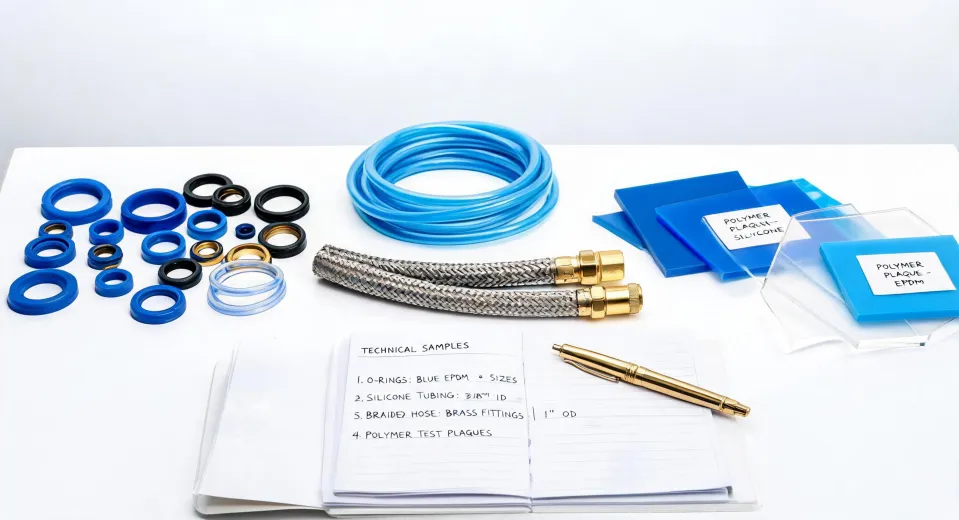
Here's where I see the blind spot in most purchasing decisions: buyers focus on O-ring size, quantity, and price. They completely miss the compatibility factor. Trelleborg's material portfolio spans EPDM, FKM, HNBR, silicone, PTFE, and dozens of specialty compounds. Every one of those exists for a reason. The reason is that rubber chemistry isn't a one-size-fits-all situation.
The question everyone asks when ordering O-rings is “what sizes do you stock?” The better question is “what compound does this application actually need?” That answer is worth the extra phone call every time.
Custom Molding: Why I Changed My Mind
I'll admit something: I used to think custom molding was a waste of time. Why wait six weeks for a custom elastomer formulation when there's an off-the-shelf part that matches the dimensions? I only changed my mind after watching a client pay for that assumption.
An automation company needed rubber bladders for a sensor assembly. They found off-the-shelf parts that met the written tolerances and ordered the cheapest option. On paper, it looked smart.
The bladders deformed after repeated compression cycles. The application had dynamic stress and temperature swings that the datasheet didn't capture. Rework cost: $3,200. Plus a week of delays. The custom compound they actually needed would've cost a fraction of that—and would've been ready in time if they'd started the conversation earlier.
Trelleborg Minnesota Rubber—the custom molding operation with roots in the original Minnesota Rubber company—handles exactly this type of work. Not just manufacturing a part to print, but engineering a compound around your operating conditions. Chemical exposure, temperature extremes, compression set over time. That kind of depth is hard to find.
To be fair, custom molding isn't the answer for everything. If you need 50 basic grommets, tooling costs aren't justified. But when the application has real demands—dynamic stress, chemical contact, tight tolerances—skipping the engineering conversation is how you create an emergency later.
Polyethylene Pipe vs PVC: A Real-World Comparison
Here's a comparison I've seen play out in actual installations: polyethylene pipe vs PVC. The spec sheets look similar for plenty of applications. The real difference is in the joints.
PVC is rigid, strong, and cheap. The downside is its joining methods—solvent welding and mechanical connections. Those joints are the weak link. They fail under thermal cycling, ground movement, or pressure surges.
HDPE, on the other hand, can be fusion welded. The joint becomes as strong as the pipe itself. When I compared polyethylene pipe vs PVC side by side on an outdoor installation in 2023, the insight finally clicked. The PVC joints were leaking after one harsh winter. The HDPE fusion welds had zero issues.
Does that mean polyethylene is always better? No. PVC still makes sense for above-ground use where rigidity matters—or where budget is the deciding factor. What I've noticed is that too many buyers default to whatever they've always specified, then wonder why the system underperforms.
The material decision isn't about which pipe is “stronger.” It's about what the operating conditions demand. That's a conversation worth having before drawings are finalized, not after the pipe is already in the trench.
Rubber Overshoes and the Self-Inflicted Rush
Some of the most expensive urgent orders I've handled are for surprisingly small items. Rubber overshoes for scaffold legs. A thermoplastic rubber ball for a check-valve mechanism. A $30 protective boot cover that somehow becomes part of a $1,100 overnight order.
Here's the pattern: the need was known weeks in advance. Nobody acted on it until the deadline was imminent. Then the rush fees kick in—40% or more on top of the base cost, sometimes double when air freight is involved.
That's not a supply chain problem. It's a planning problem. A $750 order becomes a $1,050 order for no reason other than delayed action.
Whenever someone calls with an urgent request for something like a TPR ball or rubber overshoes, I ask one question: “Was this requirement known more than a week ago?” If the answer is yes—and it usually is—then the conversation shifts. The supplier isn't the bottleneck. The internal process is.
Addressing the Objection: “But Custom Takes Too Long”
I know what procurement teams are thinking. “Custom compounds take six weeks. I can't wait that long. I need a working part now.”
Granted, engineered solutions take time on the front end. But let's do the math honestly:
- Off-the-shelf part that fails in service: original lead time, plus replacement lead time, plus downtime, plus double installation labor, plus the cost of the failure itself.
- Custom part engineered correctly: one lead time, one installation, done.
A “fast” off-the-shelf solution that fails ends up taking longer than the custom route would have. And it costs more. The lowest quoted price is rarely the lowest total cost when you factor in rework, downtime, and emergency shipping.
What I mean is: the speed you think you're buying with an emergency order is often an illusion. It looks fast right up until the part fails and you're doing it all over again.
The Efficiency Lesson
After years of coordinating these orders, I've landed on a conclusion that might not make me popular in the logistics world:
Efficiency isn't about moving faster. It's about specifying correctly the first time.
Trelleborg's real value isn't the product on a shelf. It's the knowledge embedded in the products—material databases, application engineers, compounding expertise, the custom development capability of the Minnesota Rubber group. Buyers who use that resource on the front end end up needing far fewer emergency shipments on the back end.
That's the pattern I keep coming back to after 200+ rush orders. Whether you're sourcing Trelleborg O-rings for a chemical process line, deciding between polyethylene pipe and PVC for an underground system, or tracking down something as niche as rubber overshoes or a thermoplastic rubber ball, the material decision is the actual project. Delivery speed is just logistics.
Get the material right, and the rush usually disappears. Get it wrong, and no shipping speed in the world will save you.