-
What Size Are Air Hose Fittings? The Straight Answer
-
Why You Should Trust This: A Quality Inspector's Perspective
-
Air Hose Fittings: Size, Thread Standard, and Connection Style
-
Trelleborg Silicone Tubing and Industrial Hoses: What to Verify
-
Plastic Welders and Polyurethane Mold Rubber: Adjacent Areas Worth Knowing
-
Where These Rules Don't Apply
What Size Are Air Hose Fittings? The Straight Answer
If you're looking for a quick answer: most industrial air hose fittings come in three sizes—1/4", 3/8", and 1/2"—with two common thread standards (NPT and BSP) and a few quick-connect styles. For a single tool on a short line, 1/4" is fine. For shop-wide distribution or high-flow equipment, go with 3/8" or 1/2".
But here's what I've learned from reviewing hundreds of hose and fitting specifications: the size is rarely what causes field failures. Thread-standard mismatches and incompatible materials do. You can match the diameter perfectly and still cross-thread a fitting because 1/4" NPT and 1/4" BSP look comparable but are not interchangeable. That's the kind of issue that reaches my inspection table far more often than a wrong-size mistake.
Why You Should Trust This: A Quality Inspector's Perspective
I manage quality compliance for polymer components at Trelleborg. Every batch of silicone tubing, industrial hoses, and molded parts passes through my team before it reaches customers—roughly 200+ unique items annually. I've rejected around 12% of first deliveries in 2024 for spec mismatches. I want to say 12%, but don't quote me on that; I'd need to pull the Q4 report to be precise.
Most of those rejections aren't dramatic. It's rarely "the hose burst" or "the fitting shattered." It's quieter stuff: an inner diameter that runs 0.3mm outside tolerance, a durometer reading two points off, a batch of silicone tubing arriving without the certification paperwork the contract required. All fixable, but all avoidable with better up-front specifications.
One batch stands out. In 2024, we received 8,000 units of silicone tubing where the I.D. was visibly inconsistent—measuring 6.2mm against our 6.4mm spec, with a normal tolerance of ±0.15mm. The vendor pushed back and said it was "within industry standard." We rejected the batch anyway, and the redo came out of their pocket. That's how it goes: one painful batch changes your procedure. Now every contract includes I.D. verification at receiving.
Air Hose Fittings: Size, Thread Standard, and Connection Style
What size are air hose fittings? Let me unpack that properly.
There are three dimensions to a fitting spec: the nominal size, the thread type, and the connection style. The nominal size (1/4", 3/8", 1/2") refers to the approximate inside diameter of the hose or tube it connects to, not the outside of the fitting. That distinction causes a lot of confusion. A 1/4" fitting has an outer thread diameter around 0.53 inches, not 0.25 inches. NPT sizes are based on the pipe's nominal inside diameter, which works out differently than most people expect.
Then there's the thread type. NPT (National Pipe Tapered) is common in North America and follows ANSI/ASME B1.20.1. BSP (British Standard Pipe) is widely used elsewhere and follows ISO 7-1. They are not compatible. A 3/8" NPT male will not seat properly in a 3/8" BSP female port. It might start threading, get snug, and then bind up. To be fair, even experienced engineers get caught by this without a thread gauge handy—NPT uses a 60-degree thread angle, BSP uses 55 degrees. From the outside, the fittings look almost identical.
Connection style adds another layer. Threaded fittings are straightforward for permanent or semi-permanent installations. Barbed fittings grip the inside of rubber or plastic tubing—the barb O.D. is designed to be slightly larger than the tube I.D., which creates the seal. Quick-connect fittings are handy for pneumatic tools, but each coupling style has its own flow restriction and release mechanism. It's not just about physical fit; the internal bore of a quick-connect can choke flow even when the threads match perfectly.
Why does this matter so much in practice? Because a field failure costs ten times more than a spec verification. Matching the thread and style correctly at the drawing board takes minutes. Diagnosing a cross-threaded, leaking, or disconnected fitting on an installed line takes hours—and usually involves unplanned downtime.
Trelleborg Silicone Tubing and Industrial Hoses: What to Verify
Trelleborg silicone tubing appears in food processing, pharmaceutical lines, peristaltic pumps, and other demanding environments. It's valued for flexibility, cleanliness, and temperature resistance. But there are a few things worth checking before you finalize a specification.
Durometer. Silicone tubing typically runs around 50-70 Shore A. In a peristaltic pump, a softer tube recovers well from compression, but too soft and it may collapse on the suction stroke. The ideal hardness depends on the pump's roller geometry and speed. The data sheet will list it, but I've seen buyers specify tubing based on I.D. alone and then wonder why the pump flow isn't accurate.
Tolerances. Here's something some suppliers won't tell you: "standard" tubing I.D. tolerances vary widely between manufacturers. A 3/8" tube from one source may measure 9.4mm inside; from another, 9.7mm. In a peristaltic pump with tight occlusion settings, a few tenths of a millimeter changes flow rate. That's why we measure every batch at receiving, not just spot-check. At least, that's how we run things here at Trelleborg—and it's caught enough issues that I'd recommend the same rigor to any buyer.
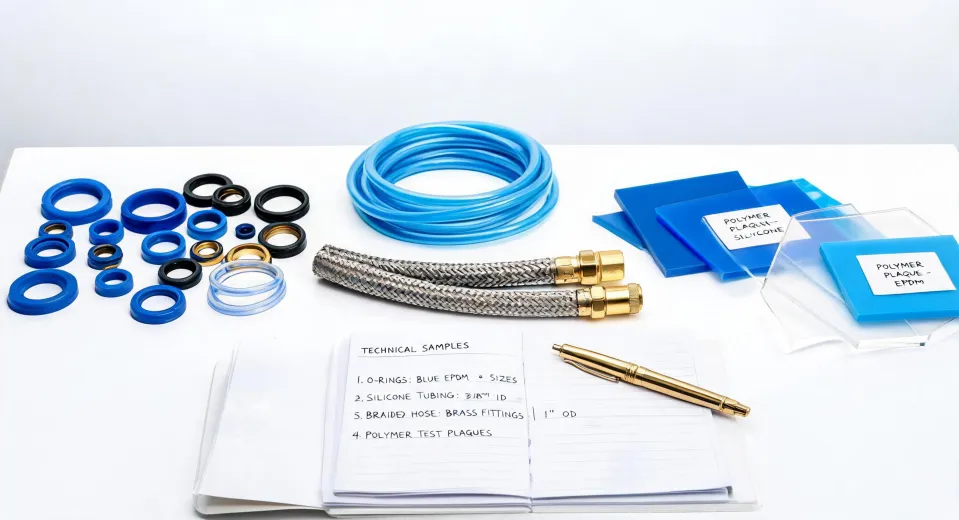
Industrial hoses are another category I review daily. Trelleborg industrial hoses come in EPDM, silicone, TPU, and other compounds for a reason: no single material covers every job. EPDM handles heat, ozone, and weather well. TPU resists abrasion. Silicone survives both high and low temperature extremes. The hose construction matters too—textile reinforcement for moderate pressures, wire reinforcement for heavier duty, and conductive rubber compounds for explosive atmospheres.
What most people don't realize is that a hose's I.D. changes under pressure. Rubber deforms. A "3/8-inch" hose at rest is not exactly 3/8" when pressurized, and it deforms differently under vacuum. Fitting and clamp selection should therefore account for working pressure, not just the nominal size. Data sheets list the working pressure, but I've rarely seen a field installation where someone double-checked that the fitting barb matched the hose I.D. at that pressure.
I went back and forth between silicone tubing and stainless steel piping for a food processing line for about two weeks. Steel had the edge in durability; silicone had easy cleaning and flexible routing. We landed on silicone for the flexible sections and steel for the permanent runs. Both materials have a place—it's about matching the product to the environment.
Plastic Welders and Polyurethane Mold Rubber: Adjacent Areas Worth Knowing
If you work with plastic welders—hot-air or extrusion types—the compressed air supply matters more than the tool brochure suggests. A hot-air welder needs steady, filtered air flow at the rated pressure. A 50-foot coil of 1/4" hose can drop enough pressure to affect weld temperature consistency. For any run over 30 feet, I'd spec 3/8" line instead. It's one of those details that doesn't show up on a spec sheet but shows up immediately in weld quality.
When welding HDPE or PVC, the weld rod should match the base polymer family. Seems obvious, but we see cross-material welds fail fairly regularly. And any rubber gaskets or seals in the welded assembly need a temperature rating that survives the welding process without degrading. Heat travels through the plastic during welding, and a seal that's right next to the weld zone can see temperatures far above its rated continuous service temp.
Polyurethane mold rubber is a separate product family, usually for making flexible molds to cast concrete, plaster, or resin. Three specs matter most:
- Shore hardness. An A-scale range of 30-60 covers most mold-making. Softer rubber releases undercuts more easily but tears faster; firmer rubber lasts longer but needs more careful release agent application.
- Working time. Pot life often falls between 15 and 30 minutes depending on the formulation. If you're casting something large, you need enough time to mix and pour before the material starts thickening. Plan your first batch like a test run.
- Cure and storage. Polyurethane prepolymers are moisture-sensitive. A container that wasn't sealed properly can absorb enough humidity to ruin the cure. Check the production date on delivery. If I remember correctly, we specify a mix ratio tolerance of ±2% by weight in our receiving inspections, and we verify it before production starts.
Where These Rules Don't Apply
Everything above assumes standard industrial pneumatic or fluid-handling applications. There are exceptions worth knowing before you commit to a spec.
Hydraulic systems are a separate world. Hydraulic fittings follow SAE, JIC, and ORFS standards and handle pressures far beyond what pneumatic fittings are rated for. Don't substitute an air line fitting on a hydraulic run, or vice versa. The threaded connections may seem close, but the pressure ratings are not.
Food and pharmaceutical applications need certified materials. USP Class VI, FDA-compliant, or NSF-rated tubing and hoses come with documentation that is as important as the physical product. If the certification paperwork is missing, treat the material like it didn't pass inspection. We do.
Specialty chemicals call for specialty constructions. PTFE-lined hoses, conductive static-dissipative hoses, and metal-braided assemblies each have their own compatibility rules. A general-purpose EPDM hose works fine for air and a range of chemicals, but not for solvents or strong acids. Check the chemical compatibility chart before the purchase order goes out, not after the drum arrives.
Precision instrumentation often uses smaller connections—10-32, 1/8", or metric threads—that fall outside the 1/4-to-1/2-inch range I've covered. These systems prioritize precision over flow volume, and the fitting standards differ again. If you're working with pressure regulators and proportional valves, your fitting requirements are a different conversation entirely.
If this feels like a lot to verify, that's fair. The goal isn't to overwhelm you; it's to help you avoid an expensive mismatch. An informed customer asks better questions, makes faster decisions, and—honestly—makes my inspection reports a lot shorter. That's the outcome everyone wants.