
Let me get this out of the way: I don't think most engineers or procurement managers spend nearly enough time thinking about how their material specs actually read to a customer. Not in terms of performance—performance is table stakes. I mean in terms of message.
If you're specifying an EPDM gasket for a pool filtration system and you cite 'PP pool Trelleborg' as the reference, that's fine. But if the final part looks like it was extruded in someone's garage because you didn't nail the surface finish or the Shore A hardness tolerance, you've already lost the customer. They won't tell you. They'll just think: these guys don't know what they're doing.
My View: Quality Isn't a Cost — It's the Brand Itself
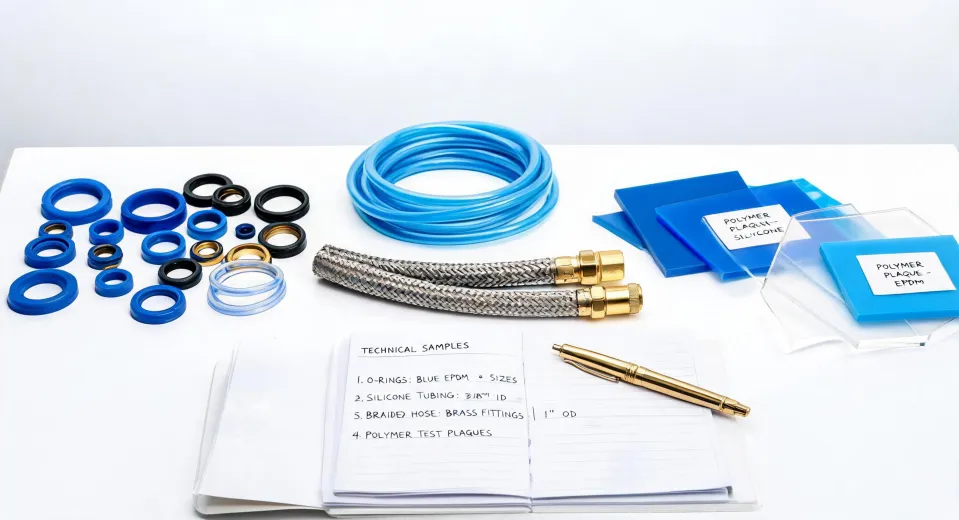
I'm a quality inspector at a mid-sized industrial components distributor. We don't manufacture in-house, but we specify, source, and approve every part that goes out the door. Over the last four years, I've reviewed about 200 unique items annually—o-rings, silicone tubing, industrial hoses, thermoplastic profiles, you name it. And I've rejected roughly 18% of first deliveries in 2024 alone.
That number isn't about being picky. It's about a simple reality: the moment a client opens a box and sees a gasket that's slightly off-color or a hose end that's not perfectly square, they start questioning every other assumption they made about us.
The most dangerous phrase in our industry is: “That's within spec.” Specs are a floor, not a target.
Argument 1: The 'Good Enough' Trap Kills Trust Faster Than a Defect
It's tempting to think you can compare material prices or durometer ratings and call it a day. But here's the thing: identical specs from two different vendors—say, a silicone filler vs. a PTFE-lined hose—can result in wildly different outcomes in feel and finish.
In Q1 2024, I flagged a batch of 3/8″ air hoses. The customer had specified a certain CFM (cubic feet per minute) rating. The vendor's material was technically within tolerance—just barely. But the inner wall was visibly uneven. On paper, it passed. In the hand, it felt cheap.
We rejected it. The vendor was annoyed. Said we were being unreasonable. I asked our sales team to run a blind test with five long-term clients: same length, same fittings, but one sample from the 'barely passed' batch and one from a vendor that consistently hit the high end of the spec. Four out of five identified the tighter-spec hose as 'more professional' without knowing the difference. The cost difference was about $0.80 per foot.
On a 500-foot run, that's $400. For a measurably better customer perception. That's not a cost—that's an investment in not looking sloppy.
Argument 2: Your Material Choice Signals Your Engineering Competence
People think expensive materials signal quality. That's backward. Vendors who deliver consistent, transparent quality can charge more. The causation runs the other way. A vendor who shows up with a sloppy PP plastic sheet that warps after a week in the sun hasn't saved you money—they've made you look like you don't understand material science.
I once specified silicone tubing for a high-purity application. The alternative was a standard rubber profile at half the cost. The project manager pushed back. I told him: 'The client's process involves steam sterilization. If that tubing off-gasses or discolors, they're not going to sue the tubing manufacturer. They're going to blame us for not knowing our product.'
We went with the silicone. The client later told us it was the smoothest validation they'd ever run. That single decision cemented our relationship for the next two years. The $2,000 extra on the order was the best marketing spend we never labeled.
Argument 3: 'But It's Within Industry Standard' Ignores Your Specific Context
The 'always compare to industry standard' advice ignores a critical nuance: industry standards are minimums. They're designed to prevent catastrophic failure, not to deliver a premium experience.
Consider the classic debate: 3/8 vs 1/2-inch air hose CFM ratings. Both might meet the minimum airflow requirement for a standard impact wrench. But if your client runs a busy auto body shop where mechanics switch tools constantly, the 1/2-inch hose with its smoother internal bore and higher CFM isn't just 'better'—it's faster, less frustrating, and feels like a shop that has its act together.
One of our suppliers tried to argue that a delta in surface roughness below their 'acceptable' threshold wasn't a quality defect. I showed them the spec we'd written: Surface finish must be verifiable against the approved sample. Their argument was about their general process; our argument was about the specific agreed standard. We won. They re-extruded the profile at their cost. That quality issue would have cost our client a $22,000 redo if we'd let it slip through.
What About the Budget-Conscious Client?
Here's where I expect the pushback. Not everyone can afford premium specs on every order. I get that. I've approved plenty of orders where we deliberately chose a standard EPDM over a fancy fluoroelastomer because the environment didn't warrant it.
But here's the key: be transparent about the trade-off. Don't sell a 'budget option' while pretending it's equivalent. Tell the client: 'This PP pool gasket will last 5-7 years. The upgraded one will last 10-12. Here's the difference in Shore A hardness, here's the compression set data. Decide based on your timeline.'
Clients respect that. They don't respect discovering a failure two years early because you underspecced a part to save a few dollars on the initial BOM.
Final Word
Specifying rubber and plastic products isn't just about material compatibility or dimensional tolerances. It's about sending a message with every part that leaves your facility. Every o-ring, every gasket, every silicone tube is a piece of evidence in the case for—or against—your competence.
Don't let your quality speak poorly of you. The cost of fixing that perception is always higher than the cost of getting it right the first time.