If you're staring at a spec sheet or a delivered part, trying to figure out if that Trelleborg rubber hose or gasket is actually the right fit, this checklist is for you. I've handled over 400 order triages in the last six years for clients in food processing, chemical handling, and construction. I've seen what happens when a product that looks right on paper fails in 48 hours because of a mismatch nobody checked. Here are the four things I verify every single time.
Step 1: Confirm the Material Isn't Just Similar—It's Exact
This is the most common mistake I see. A spec sheet says 'silicone tubing,' and someone grabs a roll of 'standard silicone.' But there's a world of difference between standard Trelleborg silicone and, say, a platinum-cured silicone used in pharmaceutical lines (like their Helix product range). People think the material is the same because the name sounds the same. Actually, the cause is usually poor specification communication.
Here's what I do: Check the durometer and temperature rating on the actual part stamp, not the brochure. For example, a common Trelleborg EPDM gasket for water systems might have a durometer of 70 Shore A and a service temp of -40°F to 250°F. If your application involves steam cleaning at 300°F, that's a failure waiting to happen.
For thermoplastics, there's a similar trap. PVC and TPU (thermoplastic polyurethane) are often confused. You might see 'PVC tubing' in a spec for a chemical transfer line, but if the chemical is aromatic hydrocarbons, standard PVC will swell. Trelleborg's TPU (like their Tempo line) would be the correct choice, but that's a conversation that needs to happen at the quoting stage, not after delivery.
In my role coordinating emergency orders for a food packing plant in March 2024, I had a client who called at 10:30 AM needing a specific silicone tubing for a hygiene-sensitive line. The normal turnaround was 3 days. We found a vendor with the exact Trelleborg PharMed BPT tubing, paid $200 extra in rush fees (on top of the $1,200 base cost), and delivered it by the next morning. The client's alternative was a $40,000 penalty for a delayed FDA audit line shutdown. That $200 saved the project.
Step 2: Measure the Geometry (Not Just the Nominal Size)
We were using the same words but meaning different things. I once had a client who ordered 'a 2-inch Trelleborg industrial hose.' They meant the inside diameter (ID). The vendor quoted the outside diameter (OD). When the hose arrived, it didn't fit the 2-inch camlock fitting. Discovered this when the hose slipped off during a pressure test.
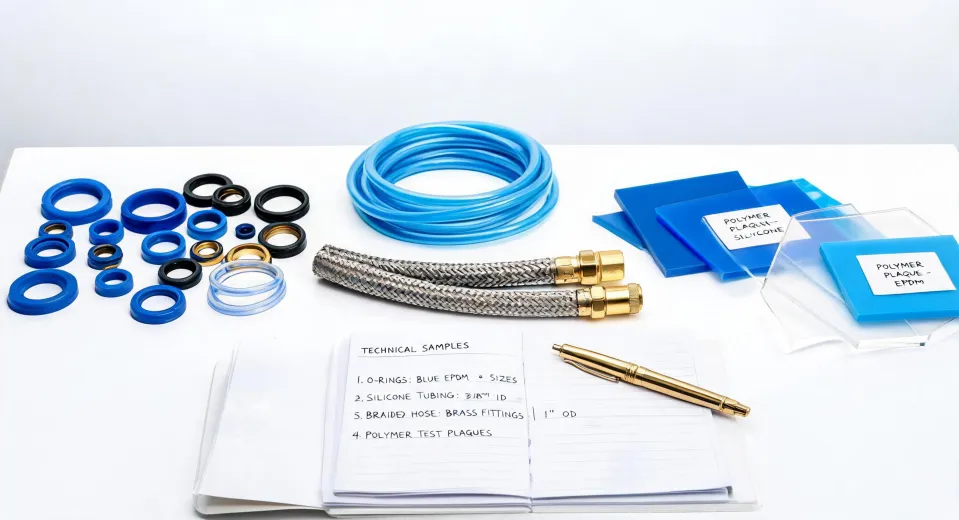
So, step two is a physical double-check. For hoses and tubing, you need three numbers: I.D., O.D., and wall thickness. A 1/4-inch ID silicone tube with a 1/16-inch wall is not the same as one with a 1/8-inch wall. The thinner wall collapses under vacuum.
For Trelleborg's O-rings and seals, don't just rely on the dash number (like -214, -326). Always measure the cross-section. A -214 O-ring has a 1/8-inch cross-section. If your groove is designed for a 3/32-inch cross-section, the seal won't work. It seems basic, but I've seen three rush orders in the last quarter fail because nobody bothered to pull out calipers. I finally created a verification checklist that starts with 'Step 0: get the caliper.' Should have done it after the first time.
Step 3: Verify the Application Environment (The 'Hidden' Factor)
The assumption is that price and material determine the cost of buying. The reality is that the environment does. A Trelleborg rubber profile used indoors vs. outdoors isn't a simple swap. UV resistance, ozone resistance, and direct chemical contact change the equation.
For instance, standard Trelleborg EPDM is great for water and weather, but it's terrible for prolonged oil exposure. NBR (nitrile) handles oil, but it can fail in ozone-rich environments near motors.
Here's a specific check: Is the product in constant contact with a chemical, or is it just splash contact? Trelleborg has a chemical resistance guide on their website. I always reference the specific chemical at the concentration and temperature the system will run at. For example, polypropylene (PP) pool trelleborg applications might use a certain grade for chemical feed lines. If the pool is using chlorine at 12% concentration at 90°F, the standard PP might work. At 120°F, you might need a different material like PVDF. Most people don't think to check the temperature of the chemical, only the chemical name.
Step 4: Check the Delivery and Storage Context (The 'Rush' Reality)
You've got the right material, the right size, and the right environment. But if it's a rush order (which, let's face it, most are), you need to ask one more question: How was it stored and shipped?
We lost a $15,000 contract in 2022 because we tried to save $500 on standard shipping for a batch of Trelleborg silicone gaskets instead of using climate-controlled courier. The gaskets were stored in a non-temperature-controlled warehouse for three days in July. The silicone adhesive backing degraded. When the client tried to install them, they curled up. The consequence was a full replacement job, a lost client, and a reputation hit. That's when we implemented our 'always verify the storage chain' policy for temperature-sensitive products like silicone and thermoplastic elastomers.
When I'm triaging a rush order, I ask: Was this product shipped in a sealed environment? What temperature did it reach in transit? For plastic mirrors (acrylic sheets), thermal warping is a real risk. I've seen a beautiful, perfectly specified piece arrive warped because it sat on a loading dock in 100°F heat. Checking how the product got to you is part of the specification checklist. It sounds extra, but I've learned the hard way that it's not.
Common Mistakes to Avoid
- Assuming 'Standard' means the same everywhere: A 'standard Trelleborg rubber' in the US might have different compounding additives than one manufactured in Europe. Always check the regional specification code.
- Skipping the pressure check for hoses: The burst pressure is not the working pressure. The working pressure is usually 25-50% of the burst pressure. If your system runs at 200 PSI, a hose with a 300 PSI burst rating won't last.
- Forgetting the 'PP Pool Trelleborg' distinction: Pool and spa products often have specific UV-stabilized formulations. Generic polypropylene will yellow and crack in 6 months under direct sun.
Bottom line: take 3 minutes to run through these four checks. It's saved me from explaining why a rush delivery failed more times than I care to count.