That First Mistake: A Fire Extinguisher O-Ring Order That Went Up in Smoke
In my first year handling seal orders (back in 2019), I got a rush request for 200 fire extinguisher O-rings. The client needed them in 3 days. I had 2 hours to decide.
I picked the cheapest EPDM option that matched the size. Looked fine on the spec sheet.
It wasn't fine.
Two weeks later, 40% of the rings had swollen and cracked. The extinguishers failed their pressure test. We had to redo the entire order — $3,200 down the drain, plus a 1-week delay and a very unhappy client.
That's when I learned: the size on a datasheet doesn't tell you half the story.
Surface Problem: Why Do Seals Fail When the Specs Look Perfect?
Most buyers focus on three things: price, durometer (hardness), and inside diameter. Those matter. But they miss the real culprit — material compatibility with the operating environment.
In that fire extinguisher case, I'd chosen a standard EPDM compound. EPDM is great for water, steam, and some chemicals. But for dry chemical extinguisher agents? It breaks down fast. I needed a formulation with higher chemical resistance — something Trelleborg's engineers could have flagged if I'd asked (note to self: always ask).
The question everyone asks is: "What's the price and lead time?" The question they should ask is: "What's the application fluid, temperature range, and any regulatory requirements?"
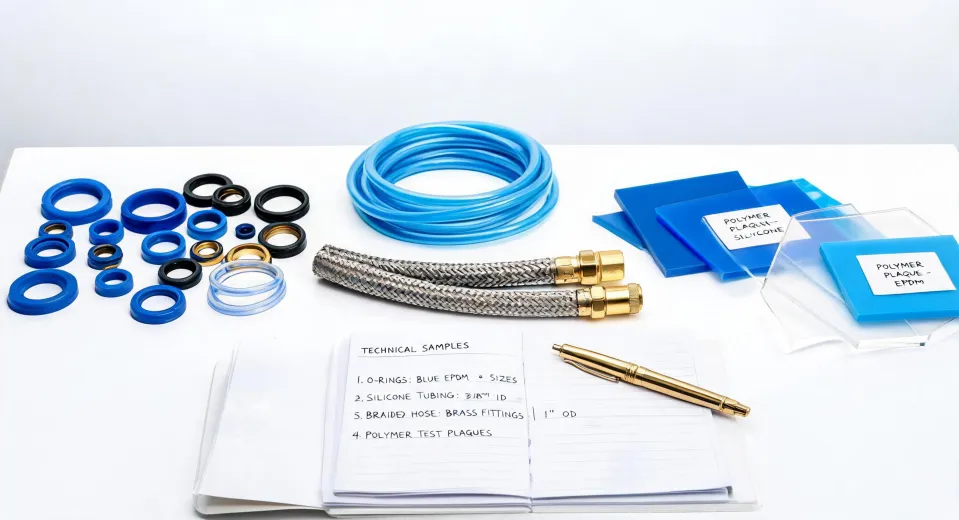
In my second year (2021), I ordered 1,000 hydraulic hose assemblies with 1" inner diameter for a construction client. The hose itself was fine — Trelleborg rubber hose rated for 3,000 PSI. But I forgot to specify the end fittings' thread type. NPT vs. BSPP? They're not compatible. That oversight cost $890 in rework plus a 3-day production halt.
The surface problem was "wrong fittings." The deeper problem? I assumed standard compatibility.
Deep Causes: The Three Things Nobody Told Me
1. Material Science Is Not Obvious
I used to think "rubber is rubber." It's not. EPDM, silicone, NBR, FKM, TPU — each has a narrow sweet spot. EPDM (which Trelleborg produces in dozens of compounds) handles heat up to 150°C and resists ozone, but it fails in contact with oils. NBR is great for oil but not for high heat. FKM handles extreme temperatures but costs 10x more.
Most buyers ignore these tradeoffs until they fail (like I did).
2. Regulatory & Standards Are Often Overlooked
Fire extinguisher O-rings need to meet specific national standards (e.g., UL/ULC in North America, EN in Europe). The material must be tested for gas permeability and aging. I didn't check. Trelleborg's technical datasheets list these certifications, but I didn't read them (I really should have).
3. "What Is Polypropylene Plastic?" — And Why It Matters
One of my biggest facepalms: ordering a batch of polypropylene pipette tips for a medical client and specifying "plastic" without checking the exact polymer. Polypropylene (PP) is a semi-crystalline thermoplastic with excellent chemical resistance, but it's not autoclavable above 121°C. The client needed autoclavable tips — they wanted polypropylene of a specific grade. The wrong grade melted in the autoclave. 500 units, $450 wasted.
The lesson: knowing the polymer family isn't enough. The exact grade and processing matter. Ask for the full material designation (e.g., PP homopolymer vs. copolymer, reinforced or not).
This cost me $450 and a good relationship.
The Price of Ignorance: Quantified
I've tracked every mistake I've made since that first disaster. Over 4 years:
- 3 significant material mismatches → $5,600 lost
- 2 fitting specification errors → $1,780 lost
- 1 polypropylene grade mistake → $450 lost
- Countless small reorders from unclear drawings → ~$4,000
Total: roughly $12,000 in waste. Not counting the credibility damage.
That's the real cost of rushing decisions.
The Fix: A Simple Pre-Purchase Checklist (That Caught 47 Errors in 18 Months)
After the third rejection in Q1 2024, I created a pre-check list for every seal, hose, or plastic component order. It's not rocket science. It's just asking the right questions before the PO is cut:
- Application environment — Fluid type, temperature range, pressure, UV exposure, regulatory needs.
- Material compatibility — Verify with supplier (I use Trelleborg's technical team; they publish compound data online too).
- Dimensions & tolerances — ISO 3601 for O-rings, SAE 100R1 for hydraulic hoses.
- End connections — Thread type, seal type, orientation.
- Polymer details — Full grade name, not just "polypropylene."
- Certifications required — UL, FDA, NSF, etc.
I also ask vendors to provide transparent pricing upfront — including any tooling charges, minimum order quantities, and rush fees. I've learned that the vendor who lists all costs up front — even if the total looks higher — usually costs less in the end. Hidden fees are the real budget killer.
Now I maintain our team's checklist. We've caught 47 potential errors using it in the past 18 months. That's a lot of avoided mistakes.
If you're ordering seals, hoses, or plastic components, don't skip the homework. A 10-minute check can save you thousands.