Back in March 2024, I got an email from our plant manager that began, "Can you source a few rubber and plastic items?"
I almost laughed. I'm the office administrator, not a materials engineer. But I've learned that "a few items" in an email is usually code for "you're about to own a small project."
We're a mid-size food packaging company, 150 people across two shifts. I handle purchasing—roughly $200,000 a year across eight vendors. I report to both operations and finance, so I get to hear about it when a part works—and when it doesn't. I process roughly 70 orders a year, and most of it is boring: gloves, pallets, printer ink. But every now and then something technical lands in my inbox. This time it was a line rework near the filling station. The list included a new flexible hose, high-temperature seals, PVC edgeband for the workstations, a PVC stand for the control box, and a pipe decision I wasn't ready for: PVC vs HDPE pipe cost.
The Quote That Almost Fooled Me
I sent the same list to three suppliers: a local plastics fabricator, an online supply house, and Trelleborg. I'll be honest—I knew Trelleborg more by reputation than by experience. A coworker had used their silicone seals on a pasteurizer and said they didn't harden like the previous ones. That was enough to get them on the list.
The online supply house came in about 18% lower—or rather, their unit prices were 18% lower. The total quote was only about 7% lower after shipping and expedite fees. And they didn't ask a single question about the application. Trelleborg's sales engineer asked what temperature the steam jacket runs at, what chemicals the hose would see during rinsing, and how long the line would be down if something failed. None of the others asked that.
I almost ordered from the cheap place anyway. Old habit. When I took over purchasing in 2020, I sorted supplier quotes by unit price and picked the bottom row. Then in 2022, I skipped getting written confirmation on a delivery date because I thought, "we've used them for years—what are the odds?" Well, the odds caught up with me. The order arrived ten days late, and we paid $2,400 in overtime to catch up. That's when I started looking at total cost instead of invoice cost.
Trelleborg Silicone vs a Cheaper Gasket
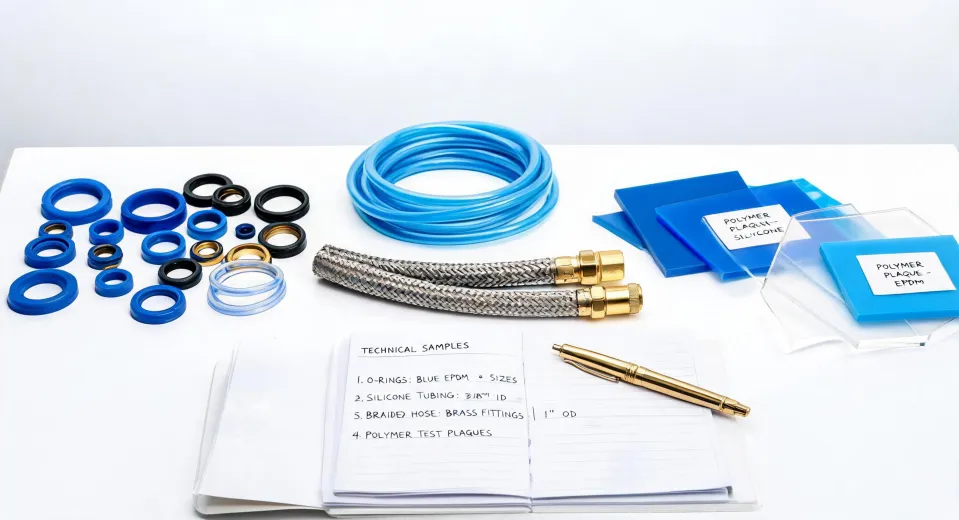
For the steam jacket gaskets, the cheaper quote offered standard nitrile rubber. It was significantly cheaper than Trelleborg silicone. But our steam jacket runs at about 160°C. Nitrile handles heat, but not continuous steam for hours. Trelleborg's silicone compound was rated for that. I'm not going to quote exact maximum temperatures from memory—that would be guessing—but their published data sheets gave a clear answer.
So glad I asked for samples before ordering. The cheaper gasket felt fine in my hand, but after one autoclave cycle it was stiff. The Trelleborg silicone sample stayed flexible. That was enough for me.
Trelleborg Industrial Hose: Price vs Total Cost
The hose was another reminder that price and cost are different. The online supplier sold generic rubber hose at $6.40 per foot. The Trelleborg industrial hose was more expensive, but it came with pressure ratings, temperature limits, and exact fitting recommendations. We needed a hose that could handle hot water, occasional caustic rinse, and the physical vibration of the pump. The cheap hose might have worked for a while. But when a hose fails, you don't just buy a new hose. You clean the floor, re-test the line, and maybe lose a shift. What I mean is: price is what you pay at the counter. Cost is what you live with afterward.
I ordered the Trelleborg industrial hose. Not because I trust the brand blindly. Because I could see what the extra money was buying: less guesswork.
PVC Edgeband, a PVC Stand, and the "Cheap Is Fine" Exception
Now for the parts that had nothing to do with steam or pressure. The PVC edgeband and the PVC stand were low-risk items. A local fabricator could cut the edgeband to length and build the stand in three days. The online place was cheaper and offered a version of the stand, but shipping took eight days. It was a simple control-box stand—not a pressure vessel. So I bought the edgeband and stand from the local shop. The total cost was slightly higher, but the speed made up for it. Plus, the local shop could answer the phone if something didn't fit.
This is the nuance I usually don't see in procurement advice: "value over price" doesn't mean "never buy cheap." It means knowing which failures are expensive and which ones are just annoying.
PVC vs HDPE Pipe Cost: The Math That Mattered
Now the pipe. This is where I sat down with the maintenance lead and did the math properly.
The cheapest option was PVC schedule 40. At the diameter we needed, the PVC pipe came in around $0.82 per foot in our March 2024 quotes. HDPE was around $1.19 per foot. On material alone, PVC wins. But the installed system was different:
- PVC needed glued joints and, because it comes in 10-foot lengths, a few more fittings. HDPE could be welded into longer runs, so fewer joints.
- The chemical rinse was diluted, but PVC isn't compatible with every cleaner we use. HDPE handled the specific chemicals on the HDPE manufacturer's compatibility chart better.
- PVC has lower impact resistance. With forklifts moving around, that mattered.
- Labor was the same hourly rate, but HDPE took fewer hours because of fewer joints.
So the PVC vs HDPE pipe cost equation wasn't just pipe price. It was pipe + fittings + labor + expected life + "what happens if a fork truck grazes it." When I added all that, HDPE came out roughly 11% cheaper over the expected ten-year life. Actually, I'm not 100% sure the exact number was 11%—I remember the conclusion more than the spreadsheet. Take this with a grain of salt, because your local prices will be different. But it was enough to make the finance team nod.
Per FTC guidance (ftc.gov), environmental claims like "more sustainable" need substantiation, and I don't have a full life-cycle analysis. So I'll just say HDPE worked better for our specific application.
What I'd Do Differently
At the end of the project, we had a functioning line and a few invoices that made the finance team raise eyebrows. Total spend was about 7% higher than the cheapest quote. But we had no rework, no leaks, no missed startup date. The maintenance lead was happy, which is worth more than any spreadsheet.
The most frustrating part of sourcing technical parts is that spec sheets don't tell you how things behave after a year of cleaning chemicals. Real-world experience matters. That's why I now ask suppliers to talk to their technical people before I order, not just send a quote.
This approach worked for us because we have a full maintenance team and fairly predictable production. If you're a one-person operation, or you're running a seasonal business with huge demand spikes, the calculus might be different. You might not have time to compare gasket grades and pressure ratings. But if you do have time, use it.
My experience is based on about 60 procurement projects in a mid-size factory, mostly with domestic suppliers. I can't speak to international sourcing, and I'm not a chemical engineer. But I can tell you this: the lowest quote I got in 2024 was not the lowest total cost. It rarely is.
Bottom line: the vendor who asks the best questions usually has the best total answer.
So if you're in the middle of your own polymer shopping list—whether it's Trelleborg silicone seals, a Trelleborg industrial hose, PVC edgeband, a PVC stand, or a whole pipe run—stop adding unit prices and start asking what a failure costs. That number, not the quote, is the real price.