You've got 48 hours and one shot. Here's how to pick your partner.
I've been in the emergency procurement game for over a decade. In my role coordinating critical material supply for industrial maintenance and event setups, I've seen what happens when a spec is off or a delivery window closes. The difference between a project that survives and one that spirals into penalties isn't always the product price. It's the certainty of engineering support and material knowledge.
This isn't a generic 'Trelleborg is great' pitch. I'm comparing two paths: betting on a premium engineering partner (think Trelleborg) versus chasing the cheapest quote for your custom rubber or plastic components (like O-rings, hoses, or PVC sheets). We'll look at three dimensions: material knowledge, total cost, and brand reliability.
Dimension 1: Material knowledge vs. part guessing
This is where most of my emergency calls start. Someone needs a replacement O-ring or a specific hose, and they've brought a bin of mismatched parts. The cheaper vendor says, 'Yeah, we have something that size.'
Here's the truth: buying from a cut-price supplier without material expertise is gambling.
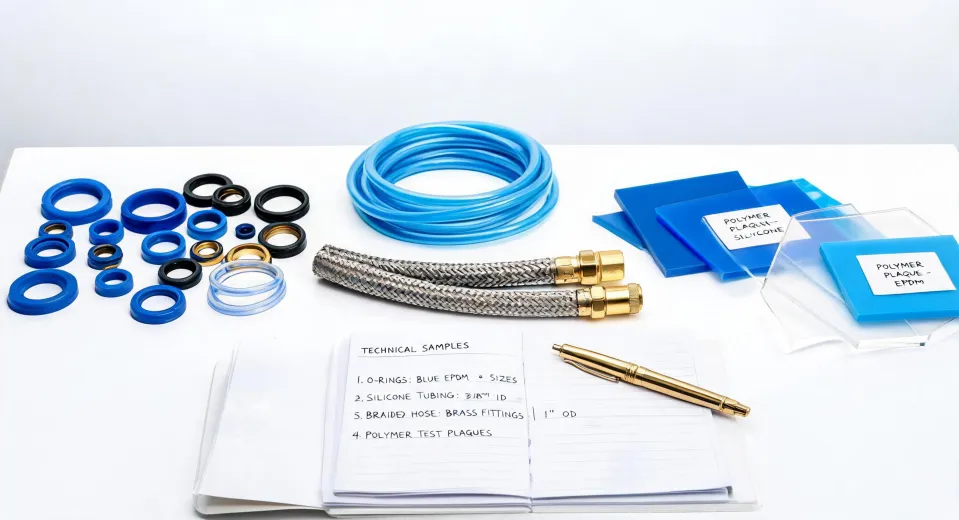
When I'm triaging a rush order for a hydraulic system, the first question isn't the price. It's, 'Do you know the durometer? Is this for a dynamic or static seal? What's the fluid temperature?' A generic supplier will offer a 'similar' compound. Trelleborg, with its broad material portfolio (EPDM, silicone, TPU, PTFE, HNBR—the list is huge), can tell you exactly why your current seal failed and what compound will survive the application. I've seen a $50 batch of cheap O-rings fail in a $15,000 valve assembly because the material wasn't rated for the operating temperature.
Honestly, I'm not sure why some discount vendors survive in this space. My best guess is they rely on clients who don't know what they don't know. But if you're reading this, you're not that kind of buyer.
Dimension 2: The total cost of checking the logo
Let's talk about the Trelleborg logo. In my first year, I made the classic rookie mistake: I ignored the brand and focused on the unit price. I ordered a batch of custom-molded silicone gaskets from a no-name supplier. They looked alright on the invoice—$0.75 per unit versus Trelleborg's $1.10. I felt clever, thinking I'd saved the project $350.
That was a beautiful mistake. The parts failed on installation. The tolerance was off, and the material had no traceability. We lost a day of production. The re-order, with rush fees and expedited shipping from Trelleborg, cost $2,300. The 'savings' evaporated.
This is the core of the total cost of ownership (TCO) argument. Let me be blunt: the supplier who can't even back up their own logo is a risk you can't afford to take.
The TCO for a critical industrial component includes:
- Base price ($0.75 vs. $1.10 per unit)
- Cost of failure (downtime, replacement labor, wasted materials)
- Cost of re-certification (if you need material certificates)
- Time cost (the hours spent chasing the problem)
- Risk of penalty (missing the client's deadline)
Suddenly, that $1.10 part from Trelleborg looks like the cheapest option. As one engineer told me (and I've stolen this line): 'A cheap seal isn't cheap if it costs you a production shift.'
A quick note on PVC sheets and silicone molds
The same logic applies. Whether you're sourcing PVC sheets for a chemical containment liner or a Danesor silicone mold for a food-grade application, the supplier's material knowledge is non-negotiable. 'Is silicone plastic?' is a question I get a lot. The short answer is no—silicone is a synthetic elastomer, not a thermoplastic. A generic supplier might not care about the distinction, but an engineering partner like Trelleborg lives in that nuance.
I've never fully understood why some buyers will spend hours bargaining over a 5% price difference on a component that can stop an entire production line. I guess we all get conditioned to look for the lowest number in the quote. But after handling over 200 rush orders across a dozen different applications, the pattern is clear: the cost of fixing a failure is always higher than the premium for quality.
Dimension 3: Brand reliability vs. 'best guess' service
A brand like Trelleborg isn't just a logo on a website. It's a global engineering organization with technical resources, material science labs, and a network of experienced application engineers. That's the 'network effect' of reliability. When you call them for a custom hose assembly or a specific O-ring compound, they have internal datasheets to pull from. They have documented history. They can say, 'Yes, we've supplied a similar compound for that exact hydraulic system before.'
A discount vendor might have a great website and fast shipping on standard stock. But when you need a non-standard silicone compound, or a specific durometer for a static seal, or a material certification for a regulated industry (like food processing or aerospace), their staff often doesn't know what's on the shelf. I've asked 'Is this material certified for contact with drinking water?' and gotten a blank stare followed by, 'I think so.'
That's not a judgment. It's just a different business model. If you're ordering a rubber gasket for a non-critical application (like a drain plug you can easily replace), the discount vendor is fine. But if your project has a penalty clause attached, or if failure means a production shutdown—you can't play the 'I think so' game.
When to choose Trelleborg (and when not to)
Here's my practical, experience-based advice:
Choose Trelleborg when:
- You need a material with specific certifications (FDA, NSF, UL, etc.).
- You need engineering support to solve a failure or upgrade a component.
- The cost of failure (downtime, penalty, rework) is high.
- You're sourcing a custom shape or a complex assembly.
- You need reliable supply with documented material traceability.
A cheaper generic option might work when:
- You're buying standard sizes for low-risk, replacement-only uses.
- You have internal expertise to verify material compatibility.
- The part is easily replaceable and failure causes no downtime.
- Speed of delivery is the absolute priority and you're buying off-the-shelf stock.
That last point is important. If you need a standard O-ring in a hurry and a local distributor has it in stock for 25% less than Trelleborg's custom option, go for it. I've done that myself (not that I'm proud of always being right).
But here's the thing: the moment you step outside of 'standard,' the calculation changes. Most of my emergency calls involve non-standard specs. That's when the engineering partner pays for itself ten times over.
In my experience, the most expensive part isn't the one you paid a premium for. It's the one you tried to save money on and had to replace three times. That's the lesson I learned the hard way with that $350 'savings' on the silicone gaskets.
The real value isn't the speed of the delivery—it's the certainty of the material. Trelleborg gives you that certainty. The cheap vendor gives you a number on a quote. At the end of the day, you have to decide which one your project can afford.
So, when you see the Trelleborg logo on a hose or a component, you're not just paying for rubber. You're paying for the knowledge of why that rubber works. And in a crisis, that knowledge is the only thing that saves you from a second, more expensive call.